Hello Heroes!
Before Monsters Are Coming became a city fleeing a relentless horde, it was a much cuter game about a hero standing on a little cube. Along the way, it featured a mechanical crane, a stationary castle, side quests, and a surprising number of frogs.
The idea of building a settlement and keeping it alive stayed with us throughout development. Finding the right way to play it took a few detours. Here is a look at some of those early versions, what went wrong, and how they helped shape the game you know today.
A tiny cube in a much cuter world
Our earliest versions used 2D sprites and a “cute but deadly” art style. Everything was more cartoonish and much less dark. Enemies included sheep and wolves. For reasons that remain unclear, frog monsters also featured heavily.


You started with a hero standing on a small cube. As you explored, you collected other cubes that attached to it, gradually building a castle around you. Your hero and your settlement were a single unit: moving meant taking the whole city with you.
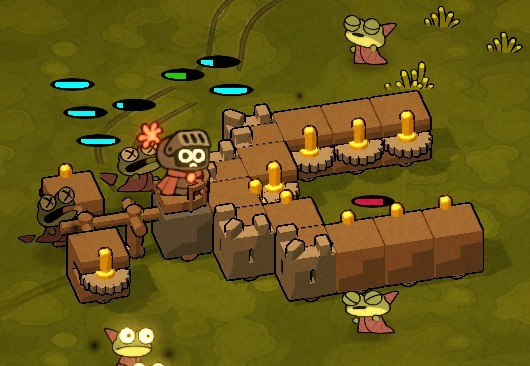
There were villages to visit, NPCs offering side quests, and creatures that were not necessarily hostile. We were exploring quite a few ideas at once.

There was also a fairly fundamental problem with our growing castle: it kept getting stuck. As the city expanded, it collided with more and more of its surroundings. Building something bigger was supposed to feel rewarding, but it could leave you unable to get through the world.
The crane era
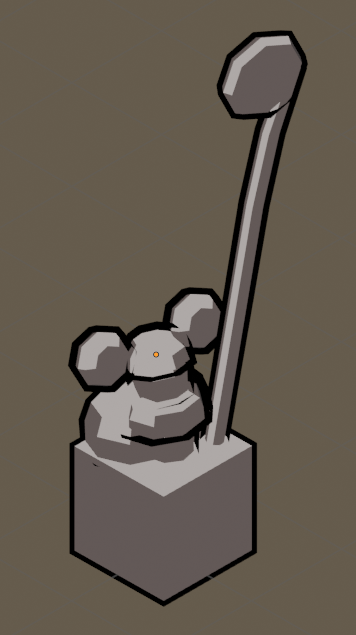
One of our longer experiments involved a mechanical arm. You used this crane to pick up blocks and place them in the city, physically assembling your settlement as you went.

The controls were cumbersome, though, and the whole process took too much time between spotting something useful and actually using it. We stayed with this version for quite a while before accepting that we wanted construction to feel much more immediate.

That experiment eventually led to the system in the game today: choose an upgrade, then place it directly in your city. The decision about what to build and where to put it survived. The crane did not.
Letting the hero leave the city

We also separated the hero from the city. You could climb down, head out to gather resources, and return to improve your settlement.
This opened up the world, but it made the gameplay loop much more complicated. The city was constantly under attack while you were away, so exploring meant leaving your home in trouble.
With the freedom to head north, south, east, or west, players also struggled to find a clear direction or objective. They got lost, and the journey back to the city could be long and uneventful.
We wanted to gather resources to give players a reason to venture out. Too much of their time was being spent simply getting back.
A castle that stayed put
At another stage, we tried a fixed castle. You explored the surrounding world, gathered resources, and brought them home to build it up.

This version also had a day and night cycle. When night fell, monsters attacked from all four directions, and the game took on more of a tower defense structure. Exploration and preparation fed into defending a single location.
It was a very different rhythm from the constant escape that would eventually define Monsters Are Coming.
Getting the city moving again
The formula finally came together when we let the city advance on its own.

The hero could gather resources around it, while a pursuing horde kept the pressure on. You had to keep moving, building up your city as you went.
This gave everything a clear purpose. Resources helped you improve the settlement you depended on, and the approaching monsters made time matter. Heading out to gather something useful became a decision about how much ground you could cover while keeping up with your city.

The moving settlement also gave players a direction to follow. It connected exploration, construction, and survival within the same continuous journey.
After all those experiments, this was the simplest and most direct version of the idea. It was also the one where the different parts of the game finally worked together.
Making the action easier to read
Alongside those gameplay experiments, we were working through another challenge: making it easy to understand what was happening on screen.
Our early 2D sprites could only face left or right. That made it difficult to judge where enemies were coming from and which way they were moving. Their hitboxes were already three-dimensional, which added another mismatch between what players saw and the space an enemy actually occupied.

Moving to 3D made enemy movement and approach directions much clearer. It also simplified asset creation for the team.


The city itself went through many changes in shape and layout. Buildings needed to remain recognizable as the settlement grew, and players needed to understand what was happening at a glance.
The art became darker along the way, moving away from the original cartoon style. Through those changes, readability remained a priority. With a city to manage and monsters closing in, there was already plenty demanding your attention.
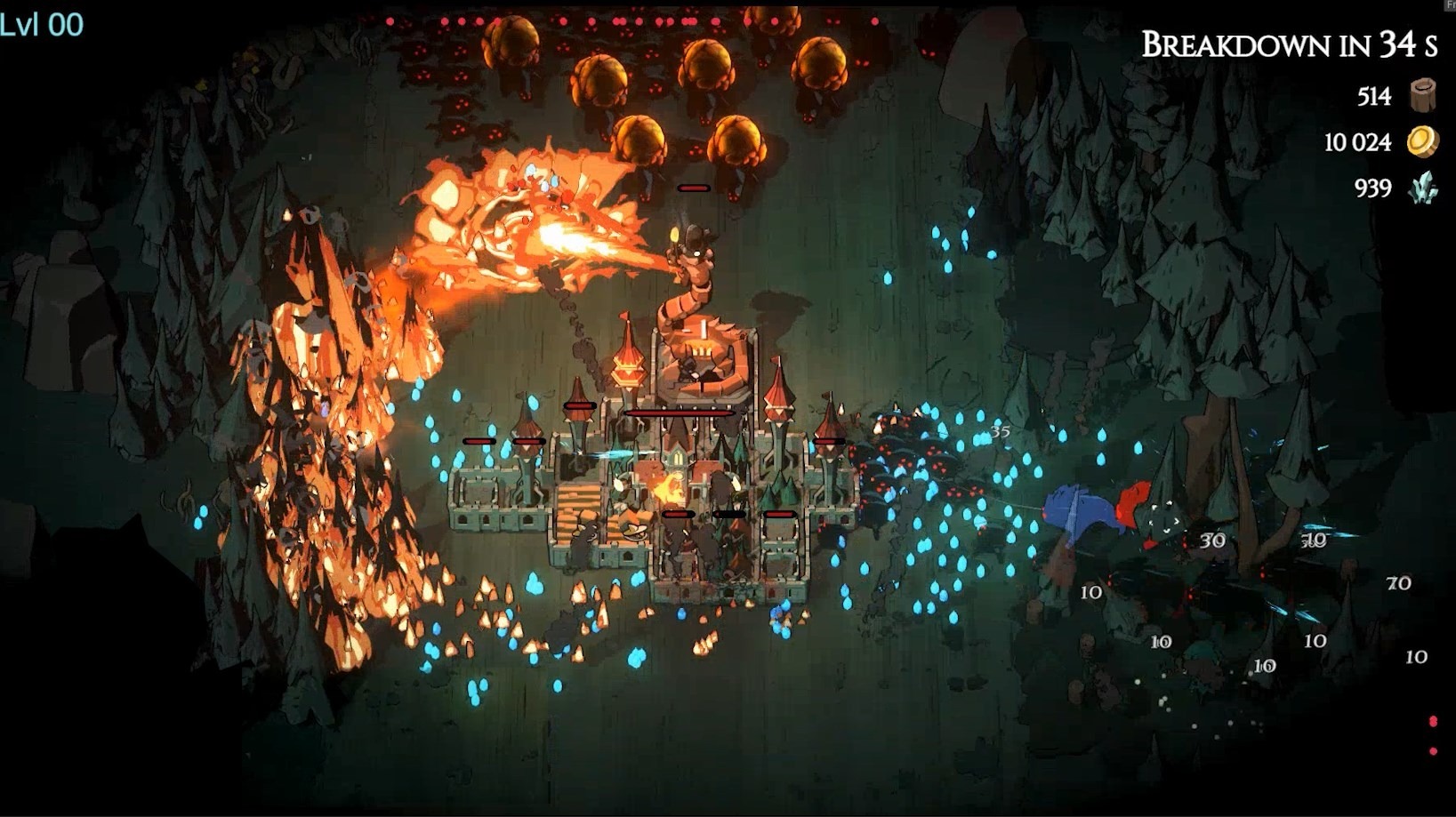
The inhabitants who never moved in
One idea we still regret leaving behind was a growing population.
For a long time, we wanted you to welcome new characters into your city: little NPCs to escort to safety, heroes to recruit, and inhabitants who would make the settlement feel more alive

We spent a lot of time exploring that idea and got a little lost in it ourselves. We never found a version that was both interesting to play and simple enough to fit comfortably into the rest of the game. Eventually, we had to let it go.
Looking back, so much of development was about finding the right relationship between the hero, the city, and the world around them. We tried moving them together, separating them, and keeping the castle in one place before arriving at the journey you can play today.
Thank you for taking that journey with us. We hope you enjoyed this look at the little cube, the awkward crane, and all the experiments that helped get the city rolling.
- Ludogram