Greetings, scholars!
Last time we sorted by state, one section each. This time, a different cut: by weapon. Two or three states' high-tier troops set side by side under one weapon, to see how the same piece of iron, in different hands, comes out fighting differently.
I. Sword
Qin's sword is strong on holding. The Soul-Terracotta Guard: heavy armour, heavy shields, and one job — taking arrows and taking men for the whole army. Three of its four skills go to holding, and only one goes forward.
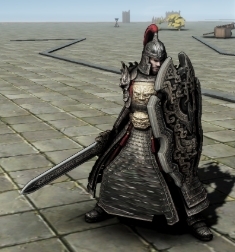
Qi goes the other way. The Jixia Sword Sage: no armour, no shield, one sword. It stops arrows by standing wide, not by plate. And it carries one more — straight for the enemy general.

Han takes a little from both. The Tangxi Sword Master: heavy armour, greatsword. Besides the usual push forward and cutting men, it stops the cavalry coming in and clears crossbowmen — in melee it alone carries both of those at once.

What all three truly share is cutting men. Qin gives the other three to holding; Qi and Han each keep one for going after a man.
A sword matches one man; not worth learning. Learn what matches ten thousand.
Records of the Grand Historian, "Basic Annals of Xiang Yu"
II. Saber
Chu's saber is an axe, and the way is straight inward. The Tianwen Guard: medium armour, twin axes; it knocks the array open, cuts infantry, and at the end goes to pick off crossbowmen and run at the enemy general.

Yan's saber is a pair, and the way is the opposite. The Jieshi Saber Sage wears the same armour, and breaks the array and cuts infantry the same; halfway in, though, it pulls out and backs off, and ends on stopping the enemy's infantry for someone else.

Same armour, same first two; only the ending differs. Chu goes deeper the longer it fights; Yan fights a stretch and falls back to hold.
We broke our axes; we notched our qiang.
Book of Songs, "Odes of Bin · Broken Axes"
III. Halberd
Qin's halberd is strong on the charge. The Chiliarch: heavy armour, one long halberd to the end; it breaks the array open, cuts at infantry, stops cavalry — and carries no second weapon at all.

Wei's halberd has the same armour and the same weapon, and gives up only breaking the array. The Mountain-and-River Army gets breaking heavy armour and taking the first shock of a charge instead, and hangs a crossbow on the halberd besides.

The two lines differ on that one item. Qin wants to press forward, Wei wants to stand; the damage Wei lacks is made up by the crossbow hung on it.
IV. Spear
Zhao's spear is three parts holding and one part attack. The Heaven-Lance Border Guard: heavy armour, spear and shield; it holds the line, stops cavalry, stops arrows, and keeps one thing that goes forward — the charge.

Wei's spear keeps no attack at all. The Mountain-Still Army, same armour and same weapon, gives up the charge for punching through iron armour, standing up to cavalry itself, and taking the shock — with a crossbow hung on the spear as well.

What they share is only holding the line and stopping cavalry. Zhao keeps one attack; Wei keeps none.
My lord bears the shu; he leads the way for the king.
Book of Songs, "Odes of Wei · My Lord"
V. Hammer
Qi's hammer is strong on breaking armour. The Daiyue Sea-Calmer: heavy armour, great hammer, every blow aimed at whoever is thickest in plate.

Chu has one that matches it exactly. The Flying-Bear Sky-Swallower has the same four skills to the letter, and differs by one grade of armour: Qi gives heavy, Chu gives medium.
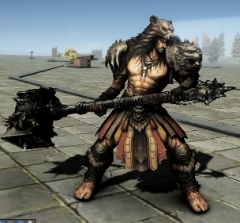
Chu has another that doesn't take this road. The Xiang-Yuan Primal Shaman: medium armour, hammer and shield; no longer working at armour, it holds with the shield instead.

Of the three hammers, the first two differ only in armour; the third turns the corner, from breaking armour to holding.
Zhu Hai carried a forty-jin iron hammer in his sleeve and beat Jin Bi to death with it.
Records of the Grand Historian, "Biography of the Lord of Wei"
VI. Bow
Qi's bow comes with a sword. The Gentleman-Archer Sage: medium armour, longbow; it shifts position the moment the shooting is done, and when the enemy closes it takes up the sword and pushes along with the front.
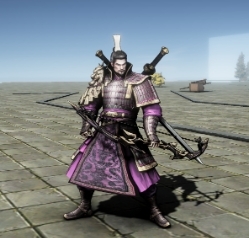
Yan's bow comes with a spear. The White-Wolf Divine Marksmen: same armour, the same longbow; what they add is meeting cavalry head-on and taking the shock, and they give ground more slowly than Qi.
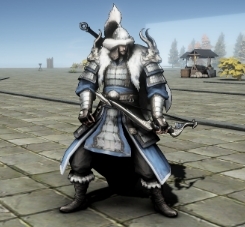
Same armour, same bow; the difference is all in the piece it comes with. Qi leans to attack, Yan to holding.
Ten thousand of Qi's best crossbowmen lay in ambush along both sides of the road.
Records of the Grand Historian, "Biographies of Sunzi and Wu Qi"; at Maling
VII. Crossbow
Qin's crossbow is one piece only. The Great-Wind Thunderclap Army: heavy armour, heavy crossbow; it pulls back once the volley is out, and picks the thickest plate to shoot at.

Wei's crossbow hangs a spear on it. The Sound-Shot Rock-Shatterers: same armour, same crossbow; besides breaking armour as before, they stop the cavalry coming in.

Han's crossbow hangs a sword on it. The Windbreaker Cavalry: same armour, same crossbow; what they add is cutting infantry at close quarters.

Three states, the same armour, the same crossbow, the same targets; split only by the hanging piece — one carries nothing, one a spear, one a sword.
VIII. Whip and Staff
Qin's mace is strong on attack. The Five-Dafu Commandant: heavy armour, twin maces; it breaks the array, cuts infantry, and can add a blow for the man beside it.

Chu's staff is strong on falling back. The Yingdu Grand Invocator: light armour, long staff; it strikes and withdraws, keeping both the added blow and stopping cavalry, and at the end can still watch the enemy general.

Only the added blow is common to both. The mace is heavy armour and goes forward; the staff is light armour and goes back. Only Qin uses the whip, only Chu the staff; there is no third state to set against them.
IX. The Last Section
The nineteen lines picked for this piece — armour, weapon and skills all sit side by side and compare directly. Two or three states to a weapon is enough; set seven or eight in a row and the difference stops being visible.
One thing more: everything here is soldiers. What generals carry is not this. Named items get a table of their own, matched to a man, one to each, with numbers and rules different from the soldier versions.
Next devlog: the weapons and named items of generals — how those blades come to rest in particular hands.
If you have suggestions, scholars, bring them on. A hundred schools contending, each taking what is good from the others, is what makes the game better.