Being primitive doesn’t necessarily need to look ugly.
Hey! Phil writing, creator and art director of DERELIKT!
Since it is my favorite topic, I wanted to talk a bit about the techniques we developed to get DERELIKTs look as authentic as possible! Plenty of modern retro-style games emulate the PS1 look with low resolutions, low poly counts, pixely textures and a TON of vertex snapping.
For DERELIKT I went on a multi-year research project and analyzed the techniques of the most impressive PS1 games. I even interviewed original art directors and developers to get real insight into the workflows of a late 90s production.
Watch side-by-side graphic modes comparison
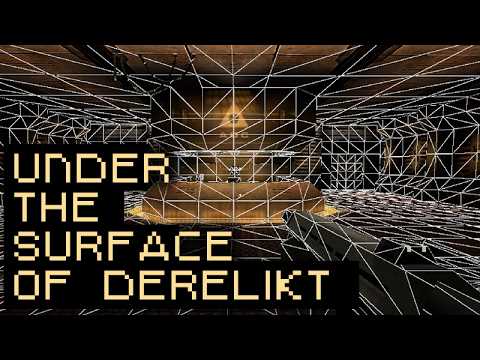
Yes, the PS1 didn’t do floating point math. Yes, the PS1 didn’t do perspective correct texture mapping, instead relying on cheaper (and faster) affine texture mapping. This meant if polygons grew too large on screen, textures warped, stretched, and swam across their surfaces.
While this effect is iconic, we tend to exaggerate the amount of warping in our memory - remember that capable and talented artists worked tirelessly against these technical limitations, and with some success I want to add.
What I learned early on: PS1 games can be surprisingly high-poly - the major strength of the console was that it could push a ton of triangles. Any flat wall is usually segmented into regular 1x1 meter tiles (one reason why most PS1 games tend to look quite blocky: the game world is already made of blocks!)
But here comes the extra secret sauce - Dynamic Subdivision.
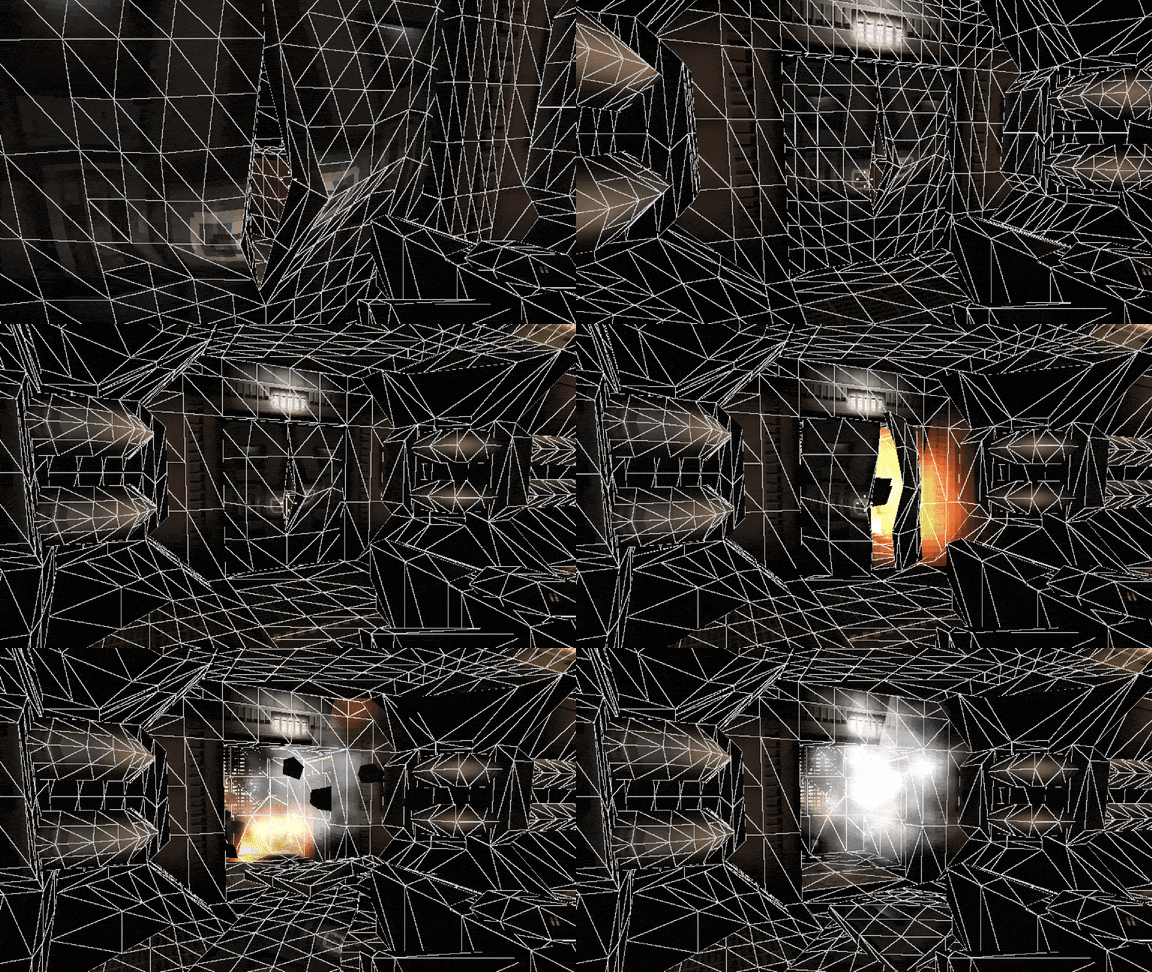
In addition to the pre-subdivided meshes, high-quality games subsequently subdivided faces into even smaller and smaller triangles, depending on their distance to the camera. This allows players to get close to geometry (like crawling through vents) without the faces warping too much. Once I learned about this technique, I knew we had to recreate it for DERELIKT.
Today subdivision like this is routinely handled by Tesselation. But Tesselation actually subdivides geometry in too optimized a manner that didn't look authentic enough. There were several different techniques to choose from - every developer back then had to code their own solution in Software.
We opted to emulate the most common method - a single Triangle becomes four, four become 16.
It looks just right - because it is.
Dynamic subdivision also leads to that characteristic "pop" at the distance where the triangles subdivide - which is the real reason PS1 games seemed wobbly. It's a small but distinctive difference.
And dynamic subdivision was just the start. I actually hand painted all static lighting in DERELIKT.

According to my interviews, some 90s artists had to select every Vert individually (!) - we could at least make use of the robust vertex painting tools in Blender.
While it may sound hair-raisingly tedious, it was actually the most enjoyable and fulfilling part of the process. Painting light and shadow like Bob Ross really transforms scenes and is the main ingredient for a high-end PS1 look.
All that said, you won’t be locked into the period-correct version of the aesthetic. We are well aware that it may be too crusty for some tastes, and that's perfectly valid.
DERELIKT lets you toggle between crunchy, era-accurate low-res and a clean high-res mode.
Texture warping and dithering can be toggled off entirely if you prefer a modern presentation.
However you play, the goal is simple: DERELIKT is intended to feel like a lost 1999 title that we found on an unmarked disc in an abandoned warehouse and ported to modern Platforms in 2026.
Join our Discord:
See you on Von Neuman Outpost.
END OF TRANSMISSION.