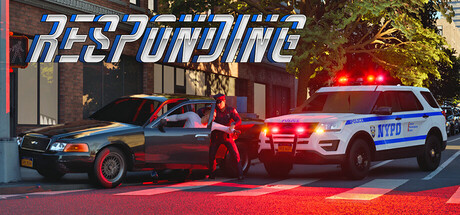
We're back with another update for Responding, bringing improvements to AI behaviour, vehicle interactions, traffic systems, dialogue and overall gameplay.
A lot of work has gone into the systems running behind the scenes, particularly making the world and its AI feel more reactive and believable. We've continued expanding civilian behaviours, improving how police units handle traffic stops, and making characters respond more naturally to events happening around them.
We haven't put together a video for this update, as our focus has been on development. We'll be sharing a more comprehensive development recap in a future video, covering some of the systems and changes we've been working on.
Here are some of the highlights of Update 0.856.
AI Behaviour & Civilian Reactions
Civilian AI can now react to any stimulus they observe, rather than having their reactions restricted by their involvement in a particular scenario.
We've also introduced new hiding and fleeing behaviours. When civilians hear gunshots, they assess the situation and react accordingly. Depending on the proximity of the threat, they may hide and cower or attempt to escape. If their escape route is unsafe, they'll remain in cover until they perceive police nearby.
AI now also considers its surroundings when making decisions. For example, civilians inside an apartment won't blindly run outside towards an ongoing incident. Instead, they'll remain inside and use their hiding or fleeing behaviours.
Another addition is our new AI look-at system. Characters can dynamically react to events and people around them. An AI taking cover might look back towards the direction they came from, while a pedestrian might turn to look at someone walking past.
We've also improved combat aiming with additional aim-offset variation, fixed issues with AI looking at targets, and resolved problems with gunshots and bullet impacts not registering correctly.
Police AI & Traffic Stops
Police AI has received improvements to its traffic stop behaviour.
Supporting units can now position their vehicles behind the primary vehicle and exit to provide support on foot. If the primary vehicle is unoccupied, officers will instead approach it directly.
Callout-generated traffic stops have also been adjusted to use the same setup as player-initiated traffic stops.
Dialogue & Investigation
We've continued developing our dialogue framework, introducing dialogue history tracking so AI can retain information that has already been established.
This means that once certain information has been learned during an interaction, players won't need to repeat the same questions to progress.
We've also improved dialogue responses to allow for more variation and give AI the ability to reference events that have already happened. This opens up more opportunities for investigating callouts and having conversations that feel connected to the situation.
For now, Domestic Disturbance is the only callout fully integrated with this system. We want to gather feedback before expanding it to every callout.
Vehicles & Traffic
Player interaction with vehicles has been overhauled to make interactions more reliable and responsive. Players can now open and close doors, interact with drivers, pull them out of vehicles, and enter every available seating position. Interactions can also be cancelled at any time.
We've introduced a new vehicle speedometer UI and improved vehicle physics sleep and wake behaviour.
On the traffic side, obstacle avoidance has been improved by reducing unnecessary processing and periodically checking for nearby obstacles rather than performing these checks every tick.
We've also reworked how deviated traffic vehicles are handled. Previously, vehicles that moved away from their intended paths could be teleported back into position, sometimes causing instability. Now, vehicles will attempt to continue towards their lane destinations using physics when it is safe to do so. Overturned vehicles will remain in place for a period before being cleaned up once they're out of the player's sight.
These changes should result in more stable and believable behaviour when traffic vehicles are disturbed.
UI & Visual Improvements
We've made several improvements to the game's presentation and interface, including adjustments to UI DPI scaling, changing certain player UI elements from black to transparent, and overhauling the game guide hint system, which now includes a notification chime.
We've also adjusted vehicle lighting and emissive intensity to reduce unwanted Global Illumination artifacts, fixed vehicle glass sorting, and corrected emergency lighting emissive configuration.
Vehicle Handling & Character Improvements
We've made further adjustments to the Voss Discovery's suspension and grip, reducing body roll while introducing more oversteer.
Character ragdoll behaviour has also been improved, alongside fixes for player damage and vehicle-related issues.
Thank you for continuing to support Responding. Your feedback helps us identify what needs attention as we continue developing the game.
Full Changelog
AI Behaviour & Civilian Reactions
All civilian AI can now react to any stimulus they observe, regardless of their involvement in the event.
Added new civilian hiding and fleeing behaviours. Civilians may hide or cower when hearing gunshots, flee when a safe escape route is available, or remain in place when escaping is unsafe until they detect police nearby.
AI now considers their home environment when making decisions. For example, civilians inside an apartment will no longer flee outside towards an ongoing incident. Instead, they will remain inside and seek cover or hide.
Added a dynamic AI look-at system that allows characters to select and react to points of interest and nearby events.
AI characters can now look towards people passing by, turn their full bodies to observe vehicle collisions, and look back towards the direction they came from when moving into cover.
Fixed an issue that prevented AI from looking at targets due to an incorrect rotation mode.
Fixed an issue where AI failed to register gunshots and bullet impacts.
Police AI & Traffic Stops
Police AI can now respond to ongoing traffic stops by positioning their vehicle behind the primary unit and providing support on foot.
When the stopped vehicle is occupied, supporting officers will exit their vehicle and stand beside the primary vehicle. When it is unoccupied, they will approach the stopped vehicle.
Police AI will now automatically disable their sirens when they enter the designated radius around their target location.
Fixed an issue with the police transport suspect mechanic.
Callout-generated traffic stops now use the same setup as player-initiated traffic stops.
Dialogue & Investigation
Added dialogue history tracking, allowing AI to retain previously established information so players do not need to ask about the same facts repeatedly to progress.
Improved the dialogue framework to support more varied responses and allow AI to reference events that have already taken place, providing more opportunities for investigation during callouts.
Vehicle Interactions & Traffic Systems
Overhauled player interactions with vehicles. Players can now open and close doors, interact with drivers, pull drivers out of vehicles, and enter any available seating position.
Improved traffic vehicle obstacle avoidance by reducing unnecessary recalculations and periodically checking nearby obstacles instead of performing checks every tick.
Improved traffic handling for vehicles that deviate from their intended paths. Vehicles will now attempt to continue towards their lane destination in physics mode when it is safe to do so, rather than being immediately teleported back.
Overturned traffic vehicles will now remain in the world for a period of time before being cleaned up when outside the player's view.
Vehicles that have only deviated from their intended path will attempt to continue driving.
Medium- and low-resolution vehicle representations now display vehicle customization changes.
Improved vehicle physics sleep and wake behaviour.
Fixed an issue that caused vehicle doors to continuously open and close when returning to high LOD.
Fixed an issue that caused emergency vehicle lighting emissive materials to be configured incorrectly.
UI & Visual Improvements
Adjusted UI DPI scaling.
Updated player UI elements, replacing opaque black backgrounds with transparent ones.
Added a vehicle speedometer UI.
Overhauled the game guide hint system and added a notification chime.
Fixed an issue with vehicle glass sorting.
Adjusted vehicle lighting's indirect-lighting contribution.
Reduced traffic vehicle lighting emissive intensity to help minimize Global Illumination artifacts.
Character & Physics Improvements
Improved character ragdoll behaviour.
Added aim-offset variation to AI characters during combat.
Adjusted the Voss Discovery's suspension and grip to reduce body roll and overall grip, resulting in more oversteer.
Bug Fixes & Stability
Added additional debug logging to vehicles, the player character, and the player controller to help identify where, when, and how players or vehicles may become fully despawned.
Fixed an issue that could cause the player character to be destroyed when their vehicle was garbage collected.
Fixed an issue that caused players to receive double damage from bullets.
Fixed an engine bug that could cause Mass actors to be pooled while they were being destroyed or possessed.