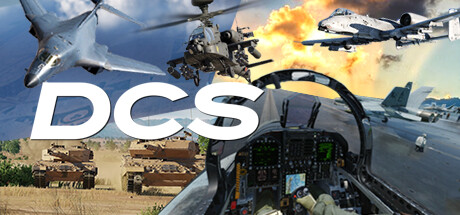
Dear Fighter Pilots, Partners and Friends,
We're excited to announce the DCS: MiG-23M Flogger, now in development by Ugra Media, the team behind the DCS: Syria and DCS: Cold War Germany maps. Plans include a full-fidelity cockpit, the Sapfir-23D radar, and R-23 and R-60 air-to-air missiles. We are really excited to announce this iconic Redfor aircraft and can’t wait to see it in action. Learn more below.
We're also taking a closer look at the real MiG-23M. This variant gave the Flogger a true look-down/shoot-down radar and became the Soviet Air Force's main air superiority fighter of the 1970s, with its first frontline regiments based in East Germany. Learn more below.
Can DCS prepare you to fly a real jet? Command T put the DCS: L-39 Albatros to the test against the real L-39, and to go with his video, the DCS: L-39 Albatros is 40% off on the E-Shop with the code CTL39. Learn more below.
After seven years, the 4YA Training Servers will close on November 1st. Server admins Rhino and Lurcher are saying goodbye with one last PvE mission on Saturday, October 31st, around 18:00 GMT, while Aerobatics Online and Project Overlord continue under new hosting. Learn more below.
Thank you for your passion and support.
Yours sincerely, Eagle Dynamics
DCS: MiG-23M Flogger Coming to DCS
from Ugra Media

Following last week's announcement of the DCS: MiG-27K, the Flogger family in DCS is growing. We're excited to announce that Ugra Media, the team behind the DCS: Normandy 2.0, DCS: Syria, and DCS: Cold War Germany maps, is developing the DCS: MiG-23M Flogger. This is Ugra Media's first aircraft module, and taking on an aircraft as iconic as the MiG-23 is no small step. Before work could begin, the team had to meet the standards we set for every full-fidelity DCS module, and they have.
Ugra Media's goal is to recreate not just how the MiG-23M looks and flies, but how every system on board works, including its real-world limitations, operating modes, and failures. To get there, the team is working from original technical documentation, pilots' manuals, electrical and hydraulic schematics, factory drawings, and archival photographs and video.
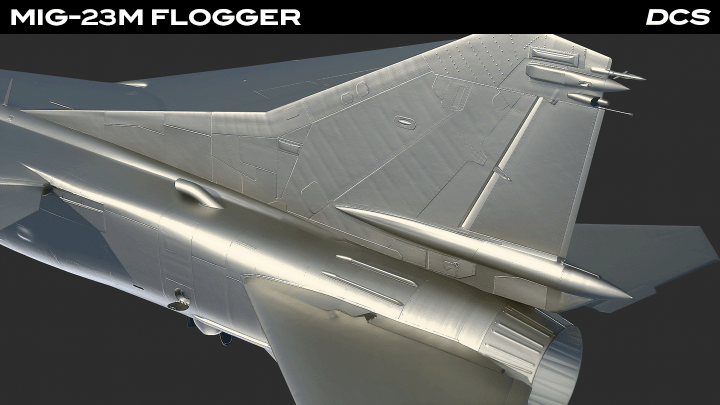
The flight model is planned to be built on real aerodynamic data, capturing how the aircraft's handling changes across the 16, 45, and 72-degree wing sweep settings, the effect of the slats and flaps, its behaviour at high angles of attack, and how external stores and fuel burn shift its balance.
In the cockpit, every switch, circuit breaker, and warning light has its own logic, wired to the system it controls. Behind the panels, Ugra Media aims to simulate the AC and DC electrical systems, two independent hydraulic systems driving the landing gear, wing sweep, high-lift devices, and flight controls, and a fuel system with automatic burn sequencing, drop tanks, and emergency fuel dump. The R-29-300 engine is planned to model everything from startup and afterburner to temperature limits, surges, and in-flight restarts, with the SAU-23A autopilot to help with workload.
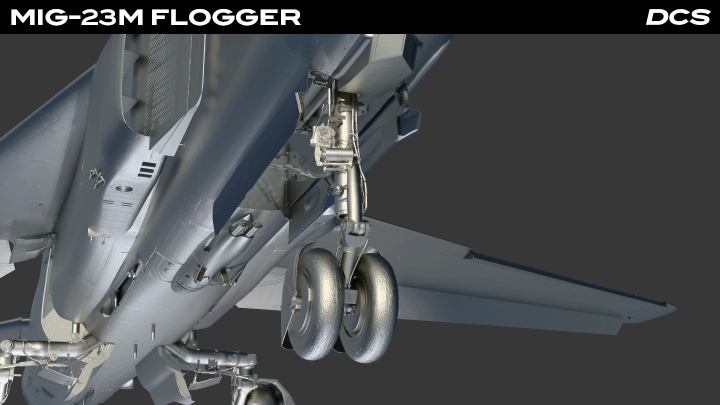 For the fight itself, the plan includes the Sapfir-23D radar, an identification system, and the aircraft's weapons computer, along with the full MiG-23M armament suite: the GSh-23L 23 mm cannon, R-23R semi-active radar and R-23T infrared missiles, R-60 short-range missiles (while these missiles are already in game, Eagle Dynamics will transition these to the new component-based model), unguided rockets, and bombs. Weapon preparation, launch limitations, and firing modes are planned to work together with the radar and sighting system, just as they did on the real aircraft.
When things go wrong, they're meant to go wrong properly. Failures are planned for the engine, hydraulics, electrical power, fuel system, radar, navigation equipment, weapons, wing sweep mechanism, landing gear, and brakes, with damage affecting each system the way it would on the real Flogger.
 We'll share more as development of the DCS: MiG-23M continues.
The MiG-23M Flogger
The Definitive Early Flogger
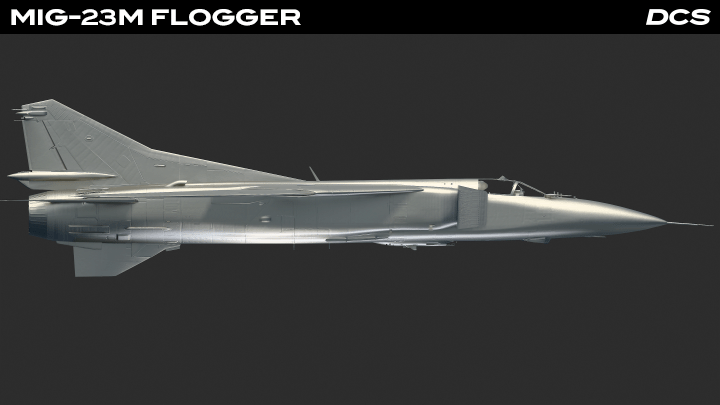 By the early 1960s, the MiG-21 was fast and agile, but its radar, range, and weapons load were holding it back. Its replacement needed a better radar, more fuel, and beyond-visual-range missiles, while also taking off and landing in a much shorter distance. Mikoyan's answer was a swing wing, and the first variable-sweep prototype took to the air in 1967.
The early production Floggers had a difficult start, but in June 1972 the MiG-23M flew for the first time, and the aircraft came of age. It was the definitive first-generation variant and became the Soviet Air Force's main air superiority fighter. Its Sapfir-23D radar gave it true look-down/shoot-down capability, making the MiG-23 the first Soviet fighter to field it, and a TP-23 infrared search-and-track sensor sat beneath the nose. It could carry a pair of R-23 missiles, in semi-active radar or infrared versions, along with R-60 short-range missiles and its GSh-23L cannon. Power came from the R-29-300, rated at 122.5 kN with afterburner.
 The pilot set the wing by hand. Fully spread at 16 degrees, it was used for takeoff, landing, and slower cruise. At 45 degrees, it was set for fighter manoeuvring and low-altitude intercepts, and fully swept at 72 degrees, it was reserved for high-altitude intercepts and high-speed dashes at low level.
Production began at the Znamya Truda factory in 1972, and by 1974 it was turning out more than thirty airframes a month. The first MiG-23Ms entered service in 1973, soon followed by frontline regiments stationed in East Germany. The Soviet Air Force and Air Defence Forces built around 1,300 between 1972 and 1978, while the export MiG-23MF, nearly identical to the version sold to Warsaw Pact allies, served across Eastern Europe. India also flew the MiG-23MF from 1981, and its R-23 missiles made it the first Indian Air Force aircraft armed with beyond-visual-range missiles.

The MiG-23M paved the way for the lighter MiG-23ML and the ultimate MiG-23MLD, and with more than 5,000 built across all versions, the MiG-23 became the most-produced variable-sweep wing aircraft in history.
When it arrives in DCS, the MiG-23M will put virtual pilots in the cockpit of a Cold War interceptor built around speed, radar, and missiles, and it comes from a team that knows the ground it once defended, having built the DCS: Cold War Germany map. Sweep the wings back and get ready to go fast.
Command T Flies the Real L-39
Plus 40% Off the DCS: L-39 Albatros
 Can a simulator really prepare you to fly a jet? Command T, who flies the Boeing 737 for a living, set out to answer that question. After weeks of training in the DCS: L-39 Albatros, he climbed into a real L-39 over New Mexico, with his instructor in the back seat, and put DCS to the test, from startup and checklists to pure stick and rudder.
For normal operations, his verdict was clear: finding your way around the cockpit, startup, and shutdown in DCS closely matches the real aircraft, with only small differences, such as a few switches that sit in different places across versions of the jet. In the air, the similarities kept coming. The roll rate, the gentle and forgiving deep stall, the accelerated stall, and the tiny amount of stick needed to pull 5G all felt just like the simulation. The biggest difference he noticed was in pitch, where the real jet felt a little crisper, especially in the flare. Overall, he gave the DCS: L-39 Albatros 9 out of 10.
Much of the video focuses on how the controls actually feel. After landing, Command T went home and re-tuned his force-feedback stick to match what he felt in the real cockpit, from the heavy, solid feel of the ailerons to the surprisingly light pitch forces and the buffet that tells you exactly how hard you can pull. His conclusion: with a good control setup, DCS can genuinely prepare you to handle the controls of the real jet, though it's no replacement for real-world flight training.
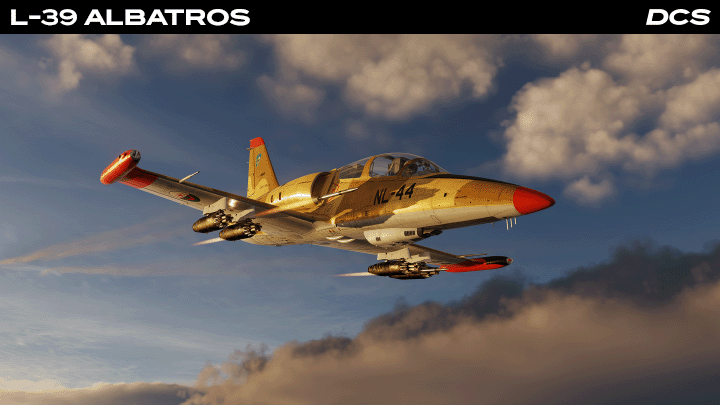 If the video has you wanting to strap into the Albatros yourself, now's the time. The DCS: L-39 Albatros, with both the L-39C trainer and the L-39ZA light attack variant, is 40% off on the E-Shop with the code CTL39, from 10.23.2026 until 12.15.2026.
Watch Command T's video, then pick up the DCS: L-39 Albatros on the E-Shop.
Community Highlight: Farewell to 4YA
A Goodbye from the 4YA Server Admins, Rhino and Lurcher
 From Rhino & Lurcher:
After seven years of service, we are resigning and closing the 4YA Training Servers on November 1st this year. Please read our full announcement at https://www.4ya-servers.nl/shutdown/.
We are extremely thankful to the DCS community, and especially Eagle Dynamics, for all their support over the years. We are also grateful to the supporters and donors who kept 4YA alive and interesting for both of us. It has been a pleasure.
We'd like you to join us for a final goodbye event on Saturday, October 31st, starting around 18:00 GMT. We'll get together in voice chat on the 4YA Discord and complete one of our PvE missions for the last time.
On November 1st, Aerobatics Online and Project Overlord, our WWII server, will continue under new hosting and new administration. We will announce their new home on our Discord that day so that these communities can continue without interruption.
Additionally, some of our veteran PvE staff are setting up a new server for modern PvE jet missions, which we will announce on the same date. We wish the new teams the best of luck.
We'd also like you to keep enjoying the missions we've built for as long as you like, so after the servers shut down, we will make our PvE missions and scripts available for download.
Thank you to everyone who has flown on and enjoyed our servers over the years. We hope to see you in the skies in DCS, now that we will have a bit more free time.
Rhino & Lurcher
Next week we will have more info on servers ready to try and help players find a new multiplayer home.
Thank you again for your passion and support.
Yours sincerely, Eagle Dynamics
THIS WEEK’S PRIORITY TASKING Check out this exciting new video from the one and only J.P. Ferré. This one is based on the true story of a B-17 Crew during WWII. Watch it here. |