Hello, Citizens!
Autumn is arriving here in Poland, and we're looking ahead to winter and the end of the year. As promised, we'll start revealing features of the upcoming Frostpunk 1886 in 2027. But we have something prepared for you this autumn, too, so stay tuned for more updates here on Steam!
This episode of Revisiting New London is dedicated to you, our community, and the legacy of Frostpunk that you continue to nurture around the world.
This time, we're joined by two guests from outside 11 bit studios: Jaime Oliveros, a lecturer at Universidad Rey Juan Carlos in Spain whose research explores identity, video games, and literature, and Jakub Wiech, a Polish journalist known for his work on energy and politics.
Together, they explore Frostpunk's ethical dilemmas, its connections to real-world crises, and the questions it raises about survival, power, and responsibility.
Check their interviews below!:
Jaime Oliveros: Ethics, Identity and Cultural Impact
Jaime's work focuses on how players and readers are affected by the stories they experience. He's particularly interested in games with engaging narratives, meaningful decisions, and complex moral questions.
When you encountered the child labour mechanic in Frostpunk, what was your scholarly reaction versus your personal one as a player?
I do not think that they were that different. Maybe the scholar one was a bit more detached. Honestly, I felt bad when I enacted it. I thought I had to, since my New London collapsed time and again. People starved, froze, or left unhappily. I started thinking about the brighter future of these children once the storm passed and automatons took over menial labor, and how, even when it was not in my hands, future settlers would revoke this edict. Let them know I did it so that New London thrived.
Scholarly, I always try to study how (and why) a particular narrative makes me feel good, bad, or anything in between. This one was clear: the ethical dilemmas that it offered, the lack of judgment, and the justified background. As such, the game had created an interesting testing ground for my own ethical standpoint. Ideally, no one should have to decide between starvation or frost, and everyone could be saved. In this scenario, however, it is highly unlikely. There are games that make players, if they are willing, consider their ethical standpoint, question it, and get away from the experience more aware of themselves. Frostpunk is one of those, and that itself makes it worth delving into.
Why has child labour become such an iconic moral dilemma in Frostpunk, even for people who haven't played the game?
I would say that there are a few reasons for this. First, child labor, in the game, is not something that comes after taking some other measures into account, but rather is one of the first edicts that the game offers, thus setting the bar for many players. “From here downward”, it seems to say. And from there it is very easy to go from “only safe jobs” to “all jobs”. Second, it is a scourge in our real world, which means that many players can relate to it more easily than, for instance, automatons killing survivors or mixing soup with sawdust. The protection of children is one of the most supported principles around the world, and many cultural productions show childhood as a stage in life that should be as happy and as best as possible (something with which I agree).
Presenting players with the chance of not giving children that, due to the cruel climate and material conditions they face, is very powerful in terms of narrative engagement, as they are addressing a societal principle that many people support, even to the point of being one of the most talked-about topics. This connection to a real-world issue also makes it easier for people who have not played the game to understand what sort of ethical decision-making Frostpunk entails. Finally, I think it feels a bit like a failure: part of the game is built around the idea of not needing many of these edicts; every time a law is enacted, New London’s citizens live a bit worse, from sawdust to the most infamous gaslighting.
 How does making players choose to enact child labour change the ethical weight of the decision compared to traditional storytelling?
In narratological terms, the spectator of a narrative experience is safer than the player in a ludonarrative experience. Spectators can relate to, or can distance themselves from, the input they have received (e.g. someone enacting child labour). Even when understanding their reasons, they can judge or admonish the main character or agree with the decision and move on. Players, on the other hand, are accepting a set of rules and establishing an illusion in which they assume the role of said main character. They are not empathizing with the Captain. To an extent, they are the Captain, and the lives of all the inhabitants of New London rest upon their shoulders, and the many ways in which the video game reacts to their input (visually, auditorily, haptically…) help maintain this illusion. This has direct implications in the way the narrative is processed. While bleeding, a term coined by Emily Care Boss that aims to explain the reciprocity in feelings and intellect between an RPG character and its player, may occur in non-interactive narratives (like books or movies), it is easier to occur, or, rather, following Kjell Hedgard Hugaas’s idea of the bleed perception threshold (the moment in which bleed becomes perceptible for the one experiencing it), players are more capable of perceiving said bleed. As such, players usually have more tools (and more ways) to be an active part of the narrative than the audience of a passively-processed narrative. This has benefits in terms of engagement, but it also has potential drawbacks: By having players more engaged with the narrative, the views and values of players merge more with the narrative. Regarding ethics, players who take into account their own principles and the dire situation the game puts them in may feel that they are becoming part of the narrative solution, and thus are more proactive in their decision-making, making that (critical) part of the narrative their own. At the same time, the risk of breaking the suspension of disbelief is bigger: Should the Captain, for instance, start making decisions without consulting players, they would not feel a problem with the narrative, but with the narrative rules they were given.
What does Frostpunk reveal about how ordinary people can justify increasingly harsh measures under pressure?
This, I believe, is better explained by Marta Fijak (Day Off Interactive) and Jakub Stokalski (11 bit studios) take on this game, when they talk about the “boiling frog” paradigm as being important for the conceptualization of Frostpunk in Procedural Storytelling in Game Design. According to them, the game offers an escalation in radicalization and authoritarianism that is progressive, rather than abrupt, until the breaking point, at which players proclaim themselves prophets or dictators, and their citizens accept these changes accordingly.
However, it must be taken into account that this enactment of harsher laws does not correlate directly with the ethics of the players: it is undeniable that many of them (myself included) enact laws because they understand that Frostpunk is a game and that they can experiment a little, pushing their own ethical boundaries to see the outcome. This is completely fine, of course: were it different, should players feel that what they were doing could be real, and many players would not have finished the game at all.
As such, the correlation is not (and must not be) perfect: despite the focus of many cultural productions and anecdotes, not that many ordinary people would be willing to justify murdering someone to take their food because they need it (for themselves or for their family). Rather, they would try to be as less extreme as possible: delving into the murder example, I feel that most people would start by finding food or asking for it, then stealing. Only then might they consider the use of force, and not all of them would do so. At least that is what I would hope for.
 What happens when players connect Frostpunk to real-world crises, even though it wasn't originally marketed as climate commentary?
Games, like many cultural products, do not have a univocal meaning or message. Rather, players face a cryptic message that they interpret and decipher. One thing is decoding the plot (which is, normally, more or less simple), and another is the many elements that are there in the game but are not explicitly addressed (for they cannot be explicitly addressed).
Is Frostpunk an intended reflection on winter crises? Players cannot know that, but they may find resemblances that help them make sense of both the event and the game. By establishing these types of connections, players develop relational knowledge that may or may not be intended in the original message, but that is there and helps them make sense of both the game and the reality they live in.
Speculative science fiction has worked similarly throughout the ages: Is a book about aliens only about aliens? Was the author intending something when he or she mentioned that aliens were evil (or good)? Readers cannot know that, and players cannot know the meaning that developers gave Frostpunk. Instead, they can only relate it to their experience and provide their interpretation of the game, which complements the original one.
Under this scope, it is hard to discern whether the message is more or less powerful, since the message is collectively created, drawn from the original source and interpreted by players (including, of course, the game’s creators).
What advice would you give developers tackling serious themes without moralising or justifying the systems they want to critique?
I do not think that it is possible to detach oneself completely from the product that is being created. As such, I would not try to do so. Instead, I would try to find a scenario where I consider the opposing view of the topic at hand not desirable, but at least understandable, and start addressing the issue from there. For instance: what circumstances would make burying the dead a commodity rather than a need? When is an animal's life more (or less) worthy than a human one? I am not a developer, but if I had this task in my hands, I would try to write the issue I want to tackle in a few words (e.g. “freedom above all”, “innocence must be preserved at all costs”), and then start offering counter-examples or limitations (“what about wrongdoers?” “Is innocence over survival?”), aiming to find dilemmas that make the principle not as strong as I thought it was at the beginning.
Then I would try to insert it into the narrative in a way that there is not a way that is clearly better than the other: many villains have honest and good intentions (in that they are attempting to make the world a better place), but are methodologically twisted. As such, I would try to create complex characters that have flaws and virtues that make them hard to just love or hate. Finally, I would offer players the chance to express themselves in these dilemmas, either by having them choose the outcome or by being able to pick sides, for instance. There is nothing wrong with not allowing players to choose, but I think that the games that have impacted me the most are the ones that have asked me: what would you do in this situation?
Jakub Wiech: Energy, Politics and Crisis Management
Jakub Wiech is a Polish journalist whose work focuses on energy and politics. His perspective explores how Frostpunk's fictional world reflects real challenges around resources, governance, and survival.
Do you see parallels between Frostpunk's governance dilemmas and real-world policy debates?
Frostpunk shows us something that today’s political debates simply avoid confronting: the fact that our entire social order rests on a fragile material foundation, with no guarantee that it will hold. We have built a world in which certain essential goods must reach people in vast quantities; otherwise, the whole structure begins to collapse.
This brings to mind the famous quote attributed to Alfred H. Lewis: “There are only nine meals between mankind and anarchy.” It captures both how easily supply chains can be disrupted and how catastrophic the resulting shortages can be.
Frostpunk offers a glimpse of humanity after it has crossed that boundary between civilisation and collapse. It does so in a somewhat exaggerated way, reversing the real-world threats posed by climate change while setting its story in an alternative industrial history. Yet the questions the game poses remain relevant to our own reality. The most important is this: what will we sacrifice to survive when we run out of the things we consider absolutely basic and indispensable?
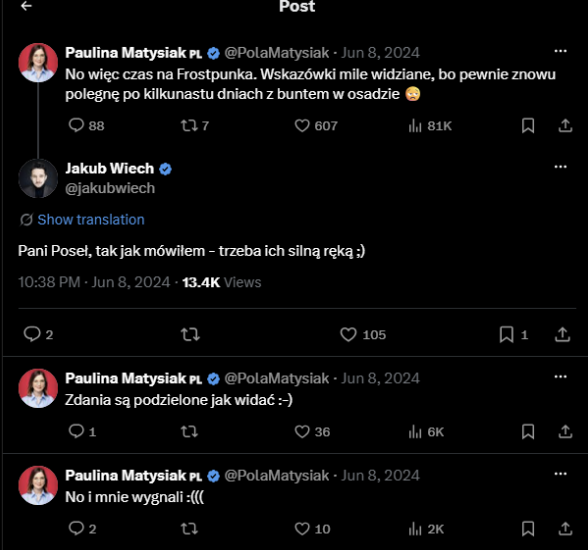 (Fragment from debate with one of the polish goverment officials on X
translation:
- So this is a time for Frostpunk. Tips welcomed, because probably again I will lose after couple of days with the riots in the City.
- Miss Deputy, as i said
- they need a firm hand
- Well opinions are divided as we can see :-)
- And again I got exiled :((( )
How does Frostpunk connect to real climate and energy crises, such as the 2021 Texas blackout?
The 2021 Texas blackout bears a truly striking resemblance to Frostpunk. A sudden blast of winter caused by a disruption of the polar vortex brought the state to a standstill. Record-high electricity demand overwhelmed the power grid, particularly as fuel supply problems also affected power plants, including coal-fired facilities. The result was one of the largest blackouts in US history, with tragic consequences for some.
It is hard to miss the parallels between those circumstances and the world of the game. But the problems depicted in Frostpunk also resonate across the 2020s as a whole. Since 2020, we have faced enormous economic, social and political challenges. The spectre of shortages, of energy, for example, keeps looming over us.
We regularly have to switch into crisis management mode and ask ourselves who should receive help first, how to keep our countries functioning, and what we can sacrifice to make it easier to navigate this new reality. Almost without us noticing, the mechanisms we know from Frostpunk have become part of our own world.
What does Frostpunk get right about how crises can justify abandoning principles, and what does it miss?
I think the game does an excellent job of capturing the moral relativism that emerges in times of crisis. When resources are plentiful and conditions are not extreme, we can afford certain comforts, not just in our everyday lives, but in our social and political arrangements as well. In the early stages of the game, keeping people’s homes warm is relatively straightforward, and we do not have to impose sweeping restrictions. But as the situation deteriorates, measures we would have found abhorrent only a short while earlier become obvious, even natural choices. We start sending children to work, lowering the quality of meals, and sacrificing the sick and elderly so that more resources are left for those healthy enough to work.
There is a story circulating online that the earliest sign of civilisation in ancient cultures is a healed human femur: evidence that someone cared for an injured person over an extended period, sharing their resources with them. There is something to that idea. Frostpunk, however, asks the opposite question: when does civilisation end? Each player can answer it differently, taking their playthrough in an entirely different direction. Unfortunately, in an age of profound geopolitical turmoil, mounting problems caused by climate change, and technological challenges, that question is no longer confined to the world of Frostpunk.
Still, and perhaps there is some comfort in this, I do not think the game fully captures the power of human determination. Hard times really can bring out extraordinary reserves of strength, ingenuity and perseverance in people. Throughout history, those qualities have helped us overcome truly formidable adversity.

How does Frostpunk capture the trade-off between immediate survival and long-term welfare?
Frostpunk shows perfectly how easily the future loses out to the present because it lacks equally strong representation, in parliament, for example. Children who, with a proper education, could become engineers or doctors in fifteen years’ time will not solve today’s coal shortage. Put them to work, and they can help immediately. The temptation is therefore enormous, especially when we are responsible for an entire community’s immediate survival. Yet this can mean surviving another day while losing the chance to find a lasting way out of the crisis.
I see a parallel here with the political debate around climate change. We now know exactly what causes global warming and how dangerous it is, and we also understand that we can halt it. Yet nobody wants to take responsibility for the truly far-reaching changes this requires.
Policymakers always look first at their current polling numbers and what drives them, because they know their votes come from people alive today, not from future generations whose welfare could be safeguarded by curbing global emissions. Nevertheless, even from this perspective, it is clear that global efforts to tackle climate change have already come a long way.
But to return to Frostpunk and the lessons embedded in its mechanics: one simplification lies in the clarity of the choices themselves. Players are given descriptions of their options and can see many of their direct consequences. In reality, we disagree from the outset about what is actually necessary, how much it will cost, and who will bear that cost.
Someone may argue that sacrificing education is essential for survival when, in practice, they are protecting the interests of a particular group. The word “necessity” can be a very convenient disguise for someone else’s gain.
That is why I would not say that child labour, for example, simply becomes necessary in Frostpunk. The game tempts us to regard it as necessary. That is an important distinction. Good governance also means checking whether we have genuinely exhausted the alternatives before shifting the cost of rescuing the situation onto those with the least say in it.
How accurately does Frostpunk portray crisis governance and the rise of authoritarian measures?
I think real-world crisis management is far more chaotic. Frostpunk offers clearly defined decision paths. Of course, an inexperienced player can get them tangled up and bring disaster upon their city, but they can still see the cause-and-effect relationships laid out by the game and plan their strategy more easily on that basis. Ultimately, it comes down to a calculation with a certain margin of error.
Reality is much tougher. Actual crisis management is one big game played under severe shortages of resources, but above all, of information. Decision-makers cannot be certain of anything. They have limited means at their disposal and often have to choose between options, none of which seems right or even adequately analysed. All of this happens under immense time pressure, with no way to pause the world.
Paradoxically, making Frostpunk even more realistic would mean adding much more chaos. But would that make the game too frustrating?
What would you tell policymakers and climate activists about Frostpunk's lessons on survival, ethics and power?
I would say: try testing the cost of your convictions when someone else is paying the bill. Frostpunk forces you to make decisions whose consequences fall on people subject to your authority. It shows how easily concern for their survival becomes a justification for denying them a voice.
For policymakers and activists, that is a valuable lesson: a just cause does not absolve you of responsibility for your methods, and good intentions do not guarantee good outcomes.
Big thank you to Jaime Oliveros and Jakub Wiech for sharing their perspectives, and to you, Citizens, for continuing to discuss, challenge, and carry the legacy of Frostpunk forward.
What's your biggest ethic diillema you have encountered in Frostunk so far? Let us know in the comments!
Stay tuned for more news from New London!
~ 11 bit studios Team
