Last month, OpenAI released its new model, Astra. Compared with previous models, it shows significant improvements in computer use, and also better reasoning ability. So I let it try playing 4D Intuition autonomously, using screenshots and simulated mouse and keyboard inputs, to see how well it could perform.
I consider 4D Intuition a particularly difficult challenge for current AI models for several reasons:
The game’s four-dimensional visuals and controls are unique, so it is highly unlikely to have encountered similar training data. This puts its zero-shot generalization abilities to the test.
It can only process visual information at relatively long intervals. Yet some techniques in the game depend on interpreting continuous motion.
The Sokoban-style puzzles in final chapters are challenging by themselves. Even with a correct understanding of the space, they still require considerable intuitive reasoning and are not solvable by brute-force algorithms.
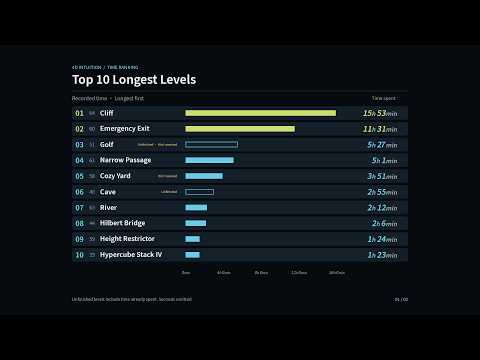
The results were surprising: Astra successfully completed most of the levels (62/64), spending about 75 hours in total. In the later stages, however, the limits of its understanding became increasingly apparent, and the time it needed per level rose sharply. Below is a summary of the challenge results, along with the time spent on each level. Let’s see how it did! Later I’ll share GPT’s own review of the game, written after the challenge, as well as its subjective ranking of the levels by difficulty. If you have any questions you’d like to ask “Professor GPT,” leave them in the comments!