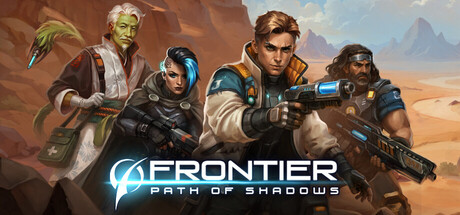
The world of Frontier existed long before the video game. It began as a setting for tabletop RPGs, changing alongside its players and gradually growing its own history, factions, and events. Years later, that material became the foundation for Frontier: Path of Shadows, where ideas originally created for tabletop play had to be reimagined through the language of video games.
Tasia Filonova, narrative designer on Frontier, spoke with Nikita Evtushenko, the creator of the setting, and Dmitry Devyatnikov, the game designer, about Golden Age science fiction, the romance of space travel, chess, Mass Effect, and how a tabletop zone-based combat system eventually evolved into the game’s network of connected nodes.
Where Did the World of Frontier Begin?
Tasia: Nikita, you started creating this world long before the video game existed. What was the very first version of Frontier like?
Nikita: I’ve always loved Golden Age science fiction, but also Sabatini, Mayne Reid, Jack London — and, of course, the tabletop RPG 7th Sea. So for a long time I had this idea of making something like “7th Sea in space”: combining the spirit of adventure and maritime fiction with science fiction.
Over time, though, I had to move away from the swashbuckling conventions of 7th Sea toward harder sci-fi, which I also love. That was roughly what the first version of the setting looked like when I started working on it back in 2008.
Tasia: And after that, the world kept evolving through tabletop campaigns?
Nikita: Absolutely. We had years of history and years of games. At first, we played freeform text role-playing games, then experimented with strategy systems, adapted the setting for Savage Worlds, and later for Year Zero. Along the way, new ideas kept finding their way into the world, and some major elements actually originated with the players.
For example, the Epsilon Sector, where the video game takes place, appeared in many of our tabletop campaigns. It was always one of the central locations in the setting. House No in Epsilon, the story of aurorite, the war with Utopia — all of that grew, to some extent, out of our campaigns and the choices players made. Even Jay and his story feel familiar to some of our old players: “That’s almost my character! She had some strange aurorite in her head too.”
Another good example is Diadem. Our very first campaign was about the discovery of a new star system. The players found a planet, named it Diadem, and later colonized it over the course of the game. Eventually, it became the foundation of one of the setting’s major factions. In the first chapter of the video game, Diadem is only mentioned, but it is a very important faction in the broader history of Frontier.
Naturally, all of these elements were reworked when we adapted them for a video game, but the roots of many storylines — and entire parts of the setting — really do go back to those old tabletop campaigns.
What Inspired the Cultures and Factions of Frontier?
Tasia: Besides Diadem, the world of Frontier includes many other factions. When creating them, did you draw on real historical cultures and societies?
Nikita: Of course. It’s practically impossible to invent an entirely new culture from nothing — you always begin with some kind of reference point.
When we created Arborea, we drew heavily on Confucian tradition and various East Asian cultures, while the Federation is based on an idealized image of Western society. Diadem, Pluto, and Centauri represent other possible paths for cultures that grew out of Western traditions. And the Freefolk are inspired in many ways by the image of a freewheeling Tortuga.
When I create a culture, I usually start with real historical examples. For instance, when I was developing the Verings (one of the Freefolk cultures in the Epsilon Sector — interviewer’s note), I drew on the maritime traditions of Scandinavian peoples and the Māori. I wanted to imagine a kind of “maritime culture in space”: to take societies where the sea and seafaring played a central role and transplant a similar way of life and worldview into a setting where space takes the place of the ocean.
In that sense, the Verings are partly an attempt to imagine what a culture reminiscent of the Māori might look like if it had developed around life and travel in space.
How Did the Game Designer Discover the World?
Tasia: So by the time development on the video game began, Frontier already had years of stories behind it and a substantial cultural foundation. Dmitry, what did the setting look like from your perspective when you joined the project as a game designer?
Dmitry: At first, I wasn’t deeply immersed in the lore. But I was always curious about the world people had been playing in for more than ten years. I kept hearing stories from old campaigns and thinking, “I want to play this too.”
In the end, I never actually got the chance — instead, I started making the video game. Once development began, I really started diving into the setting: reading the materials and figuring out how the world worked.
I’m a big fan of space science fiction in general: Star Trek, Firefly, Battlestar Galactica, The Expanse. What attracted me to Frontier was that it sits fairly close to hard sci-fi, which isn’t that common in role-playing games. On one end, you have very complex, rules-heavy systems like Eclipse Phase or space-oriented versions of GURPS; on the other, you have space fantasy like Starfinder or Star Wars. Frontier occupied a middle ground that I found very interesting.
Which Games Were the Main References?
Tasia: You clearly came to the project from different directions. What existing games did each of you have in mind while working on Frontier?
Nikita: If we’re talking about the games I was playing in 2008, when I first started creating the setting, then there was Star Control, Elite, Descent, Sid Meier’s Alpha Centauri, and, of course, XCOM. XCOM isn’t exactly about space adventures, but it’s hard to leave it off a list like this.
Dmitry: It’s important to separate our roles here. The lore of Frontier is primarily Nikita’s work. My references mostly had to do with figuring out how to turn that material into a video game.
For combat, XCOM was an obvious reference point: a tactical battlefield, a small group of characters, abilities, progression, equipment. But one of the biggest inspirations for me was, perhaps unexpectedly, chess — especially the middlegame and endgame.
I liked the feeling of a small board with only a handful of pieces left, each with different capabilities, while both sides try to use them as effectively as possible. Frontier works on a similar principle: Jay, Rob, and Alice differ from one another almost as fundamentally as different chess pieces do, except each of them has far more possible actions.
So in my head, the idea was something like space chess.
How Did the Tabletop Zone System Become Connected Points?
Tasia: Visually and structurally, though, the battlefield in Frontier doesn’t really look like a chessboard or an XCOM grid. So where did the system of connected points come from?
Dmitry: That came directly from the tabletop version of Frontier.
The tabletop RPG uses a zone-based combat system. Instead of a grid, the battlefield is divided into meaningful areas: a zone behind some crates, a zone with a cannon, a zone on high ground, and so on.
We translated that principle into a digital format, and that’s how the nodes appeared. Each node essentially represents a separate area where characters can stand and which gives them certain options.
So visually, the player sees a node, but it’s better to think of it as a zone. XCOM gave us a general language for tactical gameplay, while the specific structure of the battlefield came from the tabletop RPG.
Where Did the Adrenaline Mechanic Come From?
Tasia: So the video game inherited not only the setting from the tabletop RPG, but also the basic logic behind its combat. Were there any individual mechanics that made the transition more directly?
Dmitry: Another mechanic that came almost directly from the tabletop game is adrenaline.
Characters gain it when something bad happens to them — for example, when they miss or take damage — as well as from certain especially impressive actions. They can then spend that accumulated resource on powerful abilities.
It creates a kind of compensation loop: you miss, but at least you gain something that may help you later. Similar mechanics exist in other tabletop RPGs and in JRPGs as well, so several different influences came together here.
What Do JRPGs Have to Do with It?
Tasia: You mentioned JRPGs. So far, we’ve mostly talked about the origins of individual combat mechanics. If we zoom out and look at the structure and pacing of the entire game, is their influence visible there too?
Dmitry: Yes. JRPGs were a major source of inspiration for me in that regard.
I like structures where there is a clear main storyline, but along the way the player encounters side characters, events, and branching paths. In Frontier, choices also tend to determine not which of dozens of completely different endings you reach, but rather how you deal with the problems that arise along the way.
In that sense, I was especially inspired by Final Fantasy — particularly VIII, X, and XV — and the Tales series, especially Tales of Vesperia. If you look at the overall rhythm of progression, the JRPG influence is definitely there.
And, of course, Mass Effect. For a story-driven space adventure, it’s almost impossible not to use it as a reference point.
Nikita: Absolutely. You can’t really avoid Mass Effect.
How Did Mass Effect Influence Frontier?
Tasia: Since you’ve both mentioned Mass Effect, let’s talk about it separately. Was there anything in particular that influenced Frontier, either mechanically or conceptually?
Dmitry: Mechanically, Mass Effect was one of our reference points for planet scanning.
Originally, we had a different system — something more thoughtful and puzzle-like. But for a mechanic that was supposed to work quickly and be easy to understand, it turned out to be too complicated. So when we started looking for a simpler and more readable approach, one of the things we looked at was how Mass Effect handled a similar task.
In the end, Frontier got its own planet-scanning system. The underlying math works differently, but the basic idea was still a useful reference point for us.
Nikita: When it comes to lore, there are even fewer direct borrowings. I usually don’t work by thinking, “I like this idea, so I’ll put it into my own setting.”
But you can see a certain similarity between one of the central themes of Mass Effect and the aurorite crisis in Frontier. Humanity encounters an alien intelligence that may be more efficient than humans, which forces people to change and evolve.
The ending of the Mass Effect trilogy has remained one of the most discussed and controversial topics among fans for years, and I understand the common criticism that such a huge conflict was ultimately resolved in a rather simple way. In the end, everything comes down to a single protagonist choosing between several possible outcomes.
I wanted to approach a similar theme differently: to show that humanity’s encounter with a fundamentally alien intelligence cannot be resolved by a single choice and inevitably becomes something far more complicated.
That said, Mass Effect is still an excellent series and one of the pillars of the genre.
How Did the Symbiont Come About?
Tasia: Speaking of alien intelligence: in Frontier, that idea becomes very concrete through the Symbiont. It’s part of the story, a character, and a game system all at once. How did you decide what interacting with it should feel like?
Nikita: Originally, the Symbiont existed purely as part of the lore. There is a much larger story behind it: how four different neural networks were combined into a single system, why they differed from one another, and how those differences manifested themselves.
But I don’t want to reveal too much. Maybe in the future, players will discover for themselves what the Symbiont’s different colors really mean and how the system works within the setting.
Dmitry: In the video game, its behavior is governed by four interconnected scales. Their balance determines the Symbiont’s color, so players can watch the crystal gradually change depending on the decisions they make.
We don’t want to reveal the exact math behind it. Part of the player’s task is to observe the Symbiont and try to figure out the patterns in its behavior for themselves.
What Comes Next?
Tasia: So many ideas in Frontier have gone through a long evolution — from tabletop RPGs and old campaigns to the mechanics of the video game. What parts of this world would you personally like to develop further?
Nikita: I’d like to release the second chapter and continue the story. That’s probably the main thing for me right now.
Dmitry: From a mechanics perspective, there’s still a lot in the game that could be expanded and polished. The talent system and progression trees, for example. But those are more like plans and dreams than concrete promises.
Quickfire
Favorite science fiction book?
Nikita: Solaris.
Dmitry: Dune.
Favorite sci-fi movie or TV series?
Nikita: Star Trek: Deep Space Nine.
Dmitry: It’s hard for me to choose just one: Star Trek, Firefly, or Battlestar Galactica.
Favorite faction in Frontier?
Nikita: Between us — the FSS. The faction is going through a rough time right now, and that makes me very sad.
Dmitry: Arborea. I’m very interested in East Asian cultural and visual motifs, especially Chinese and Japanese ones, so that choice was pretty obvious for me.
Favorite character in the video game?
Nikita: Surprisingly, Marco. He was also an NPC in the tabletop RPG. Marco is never at the center of the story, but he keeps showing up here and there and becomes one of those little details that make the world feel alive. He’s a bit like the cabbage merchant from Avatar.
Dmitry: Probably Marco too. His relationship arc with Alice turned out to be very interesting.
Describe Frontier in three words.
Nikita: Deep space romance.
Dmitry: Adventure, space, transhumanism.
What should people read, watch, or play after Frontier if they want to stay in a similar mood?
Nikita: Andre Norton’s Solar Queen. It was one of the first science fiction series I ever read, and it captures that sense of space adventure extremely well.
Dmitry: For something more modern, I’d recommend Ann Leckie’s Imperial Radch trilogy, beginning with Ancillary Justice. It’s a story about space adventure, transhumanism, and an intelligence that perceives the world very differently from an ordinary human being.
Tasia: Perfect. So after Frontier, we’re sending everyone off to read science fiction.
And now it’s your turn. If this interview left you with questions about the world of Frontier, its characters, factions, mechanics, or the development process itself, leave them in the comments.
We’ll collect your questions, pass them on to the team, and do our best to answer the most interesting ones — either right away or in future posts.