Hi everyone,
Trails beyond the Horizon is releasing today, and as always with our PC ports, it's my pleasure to share some information about the features and improvements, and also some - hopefully amusing - anecdotes from the development.
On a technical level, this release is a continuation of Trails through Daybreak 1 and 2, which are games where we already tried to include everything and the kitchen sink in terms of PC features - something at which we succeeded pretty well! We included almost everything from those releases in this game, which also goes for improvements made post-release. To elaborate a bit on what this means, I'll briefly recap the most important features which have been carried forward.
PC Features Carried Forward
- Arbitrary resolution and aspect ratio support. As always, we don't just mean "16:9 and 21:9", but actually "arbitrary". Want to play in portrait mode? I don't know why you would, but you can. This is quite a lot of work to get right across the many UI elements in a fully-featured JRPG.
- Variable frame rates up to 360 FPS supported in-game -- up to 500 FPS via config file, but no guarantees on that.
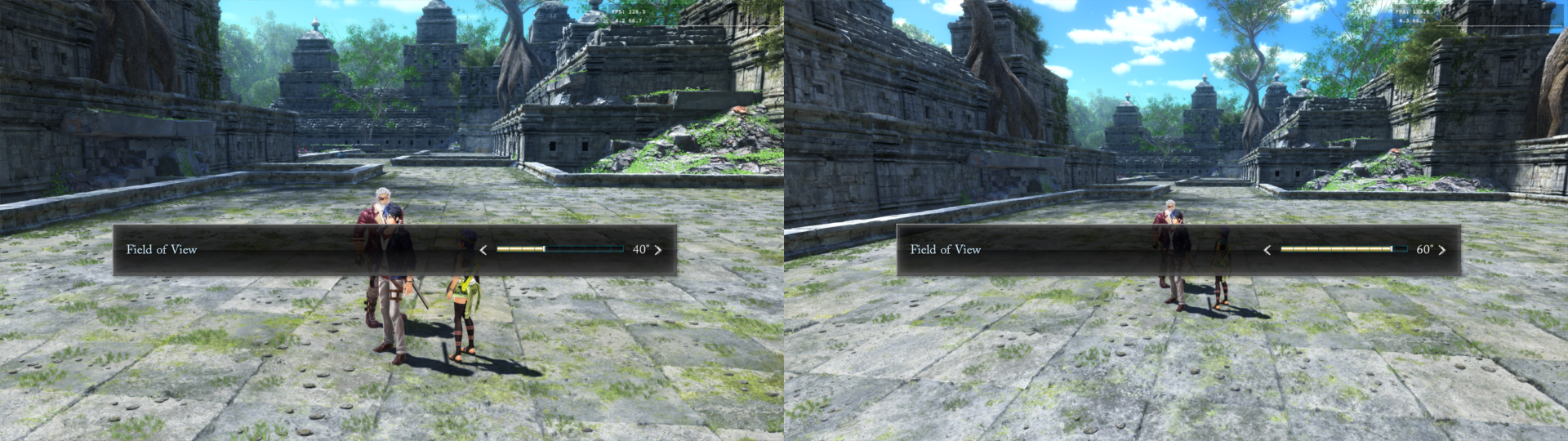
- Fully configurable Field-of-View (FoV). I had really hoped that by 2026, this wouldn't even be worth mentioning, but sadly there are still a great many ports out there, particularly in this genre, without adjustable FoV.
- A wealth of graphics options, here are a few of them:
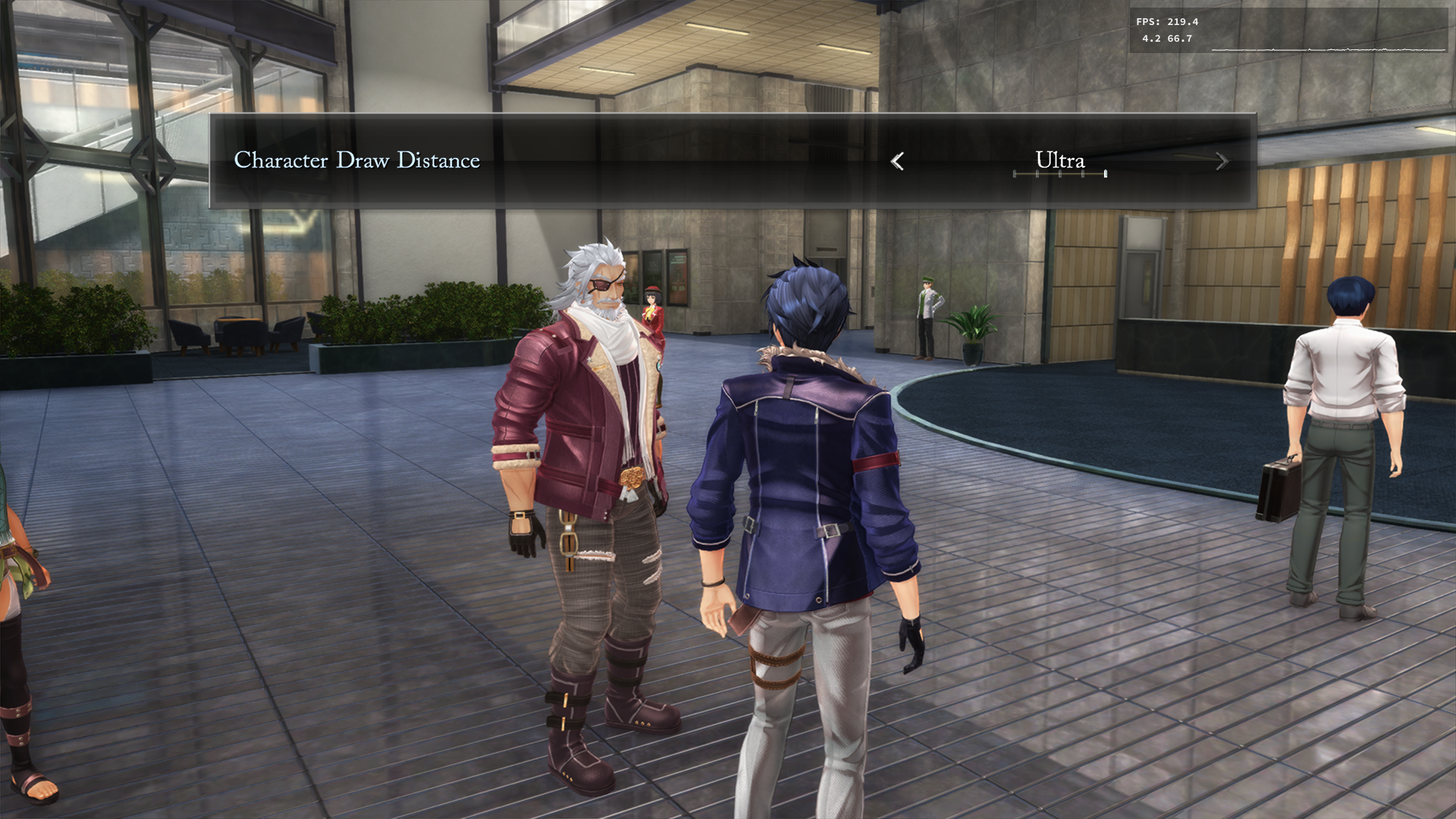
- Configurable level of detail and draw distance for characters, environment, and lights, with a very large range from low to ultra.
- Shadow quality options, including resolution and filtering, with high-end options for variable penumbra PCSS shadowing and high-quality HBAO+ local environment shadows.
- Highly adjustable rendering quality with FXAA/TAA/XeSS/DLSS options, as well as portrait supersampling, minimap anti-aliasing and more!
- Scalable quality for screen-space reflections, volumetric lighting, tesselated water rendering, high-resolution cube maps, and more, from settings appropriate for Steam Deck to ones that go far beyond the console versions and can put high-end PCs to work.
- Live Preview of all applicable graphics options:
- Configurable level of detail and draw distance for characters, environment, and lights, with a very large range from low to ultra.
- Various general and gameplay features and improvements:
- Asset caching for blazing fast loading times.
- Configurable multitasking behaviour - choose whether to pause on overlays or focus loss, whether to confine the cursor, and whether to continue playing audio when in the background.
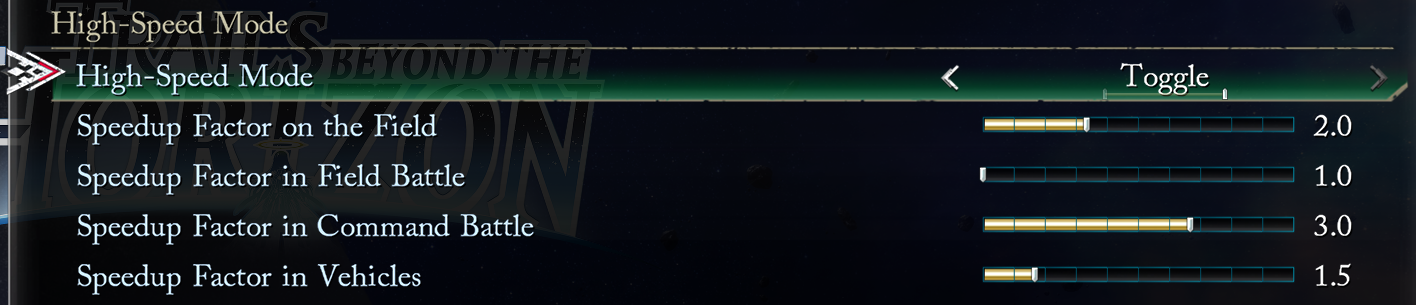
- Turbo mode supported as either a toggle or hold-down action, and with an individual choice of speedup factor for various game scenarios (of which there are now even more).
- Highly configurable message auto-advance.
- Timed autosaves with a large number of slots so you never lose any progress.
- Additional battle information options such as always displaying the turn order.
- Asset caching for blazing fast loading times.
- Fully customizable input specifically tuned for PC:
- A new targeting mode optimized for mouse: "Free Look". This works quite differently from what the console version does, but our testers who play with mouse and keyboard love it. Do give this a try if you are interested!
- Additional direct shortcuts for various (sub-)menus, such as directly going to the items screen (with the default shortcut "i"). A keyboard has a lot of keys, and there's no reason not to use them.
- Full cursor-driven mouse menu support across the many UIs in the game. This is just another point in this list but it is a very non-trivial amount of work.
- Dynamic automatic or manual button prompts, which respect your custom rebindings, and can also show secondary bindings.
- A new targeting mode optimized for mouse: "Free Look". This works quite differently from what the console version does, but our testers who play with mouse and keyboard love it. Do give this a try if you are interested!
- Bonus features and full platform support:
- The fan-favorite background music information display feature returns once again - including information regarding the origin of each music track.
- Steam Recordings timeline support with event and game mode tracking. Since this is still very rarely supported, if you have no idea what this is then read more here. We have some new markers for events unique to this game!
- As always in our releases, you can launch directly into where you left off from Steam, skipping all menus and intro screens. This is hardly new, but it's still extremely rare outside of games released by us, so I thought I'd mention it.
- The fan-favorite background music information display feature returns once again - including information regarding the origin of each music track.
New PC Features in Horizon
While our existing feature set is quite extensive, there are still also some new features to talk about that make their first appearance in this game.
Transparent UI VFX Anti-Aliasing

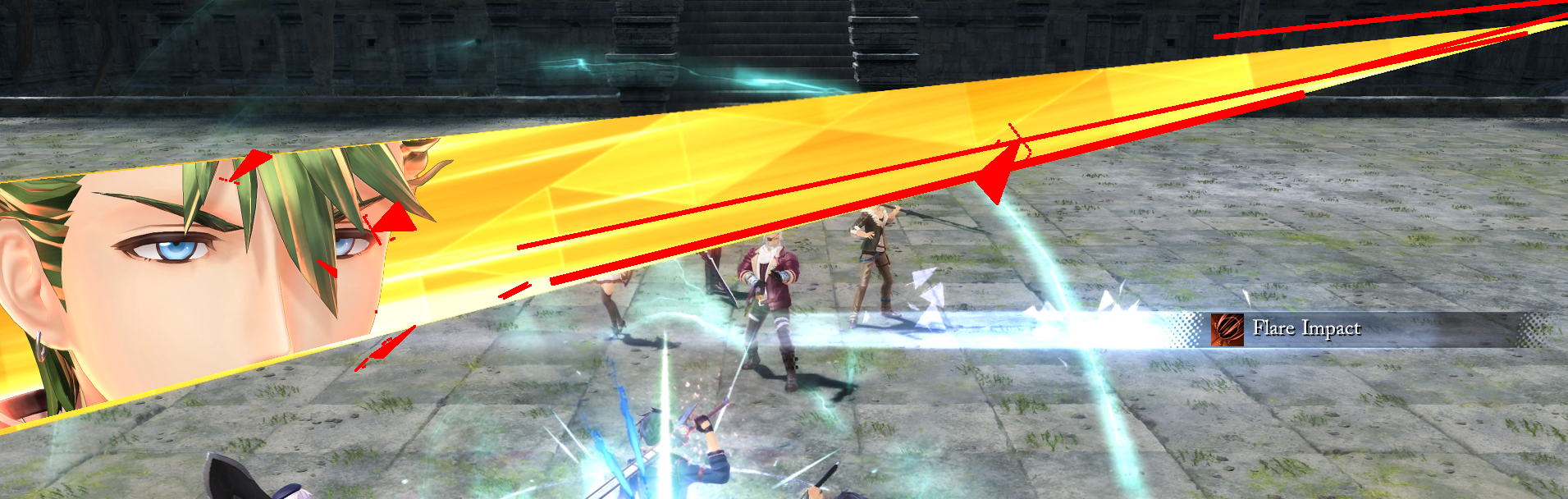
One of these is quite simple: in addition to plenty of in-game anti-aliasing modes, we also already featured a minimap anti-aliasing setting (that I'm still very proud of and wish was adopted more widely), and a portrait supersampling setting. However, there is one particular rendering pass that escaped all existing anti-aliasing methods. The details are a bit complicated, but the result is that in addition to main game render scale, main game anti-aliasing, portrait supersampling, and minimap anti-aliasing there is now also a "Transparent UI VFX Anti-Aliasing" option. This graphics debugger screenshot shows an example of the elements that are affected by this setting highlighted in red:
Further Improved Scalability
I like to believe that our ports are already very scalable, from running well on the Steam Deck all the way to fully utilizing a high-end gaming PC. However, also working on portable console versions of this particular game had us improve this scalability even more, resulting in three new settings: "Detail Draw Distance", "Detail Density", and "Fog Particles". The former two are much more impactful in general, while the latter only affects a few scenes.
The following comparison provides a quick impression of the impact of these new settings (and some of our existing draw distance / LoD settings), comparing Low and Ultra presets:
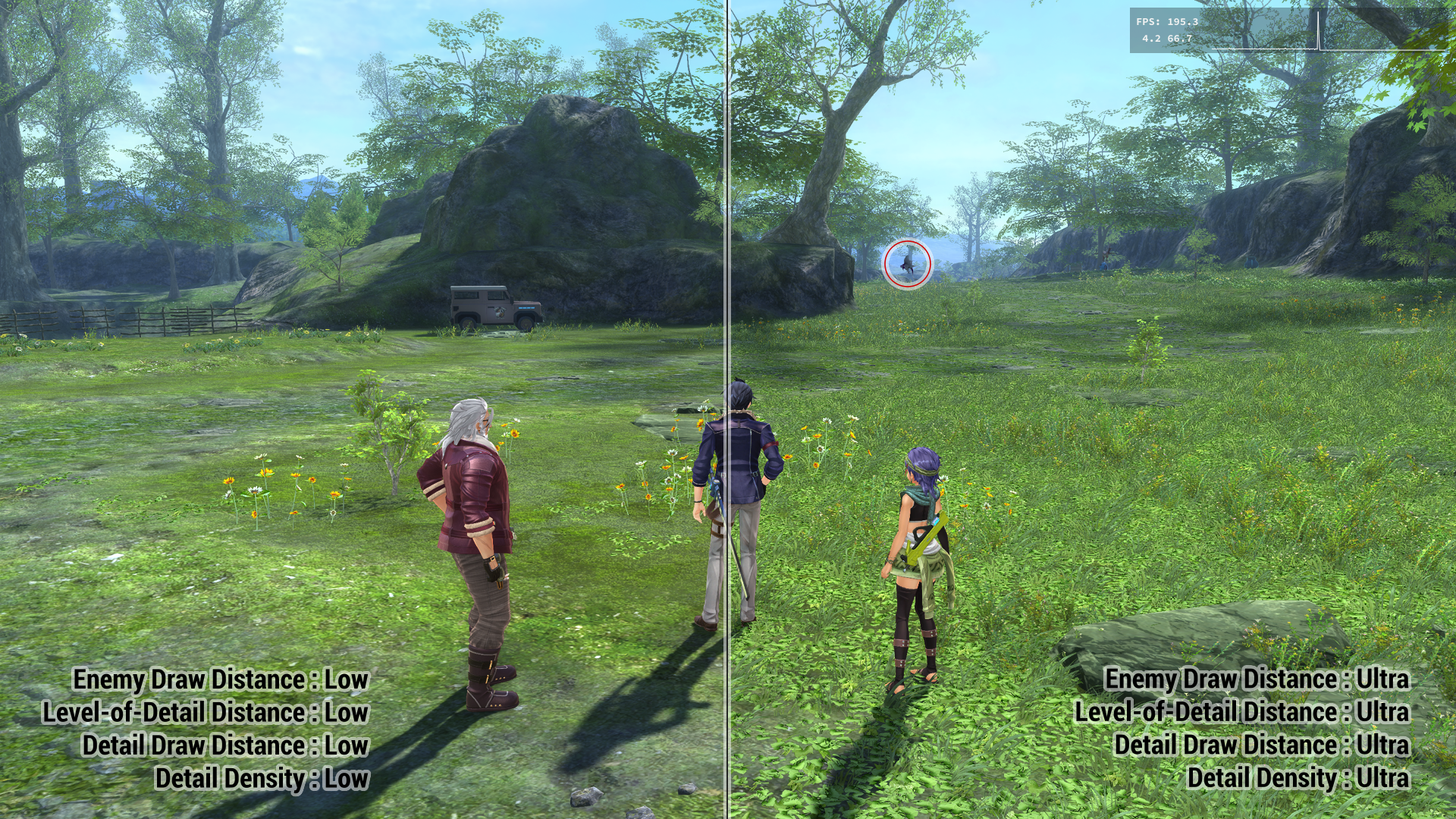
As always, I'm personally very particular about pop-in, so maximizing all draw distance settings comes with a rather significant performance impact. Don't do it if you don't care deeply about that aspect.
Protecting Players From Themselves
One thing I have learned over my time doing feature-rich PC ports is that some players don't read. I feel confident in ranting about this for a bit because I am pretty sure that everyone who reaches this point is not in that group.
To be clear: it's obviously not the job of someone who just wants to play a game to care about technical minutia - that's why we have plenty of hand-tuned graphics presets that you can select from with a single choice at the very top of the options page. What is a bit draining at times is when someone does not use those presets, but rather goes down to the individual settings and selects "Ultra" everywhere, completely ignoring even BRIGHT RED WARNING TEXT, and subsequently complaining about the resulting performance (even though they e.g. selected settings that go beyond the PS5 Pro configuration while running on a sub-PS5-level PC).
A simple "solution" to this issue is simply not allowing settings that go substantially beyond the console versions, especially in regards to aspects such as draw distance of foliage. I find that a predictable but counter-productive outcome.
Instead, I mostly believe in letting people shoot themselves in the foot rather than arbitrarily capping the high-end scalability of a game. For me, one of the many great things about PC gaming is that a good PC version can benefit from future hardware without re-buying some remaster.
However, there is exactly one particular scene in this game where this principle isn't enough. In it, a grain field that simply serves as scenery is rendered using the general detail/clutter/foliage system, and as such, it is also affected by our "Detail Density" setting. In this case, that can lead to utterly absurd amounts of individual, fully modeled stalks of grain being rendered, tanking performance on even very fast systems.
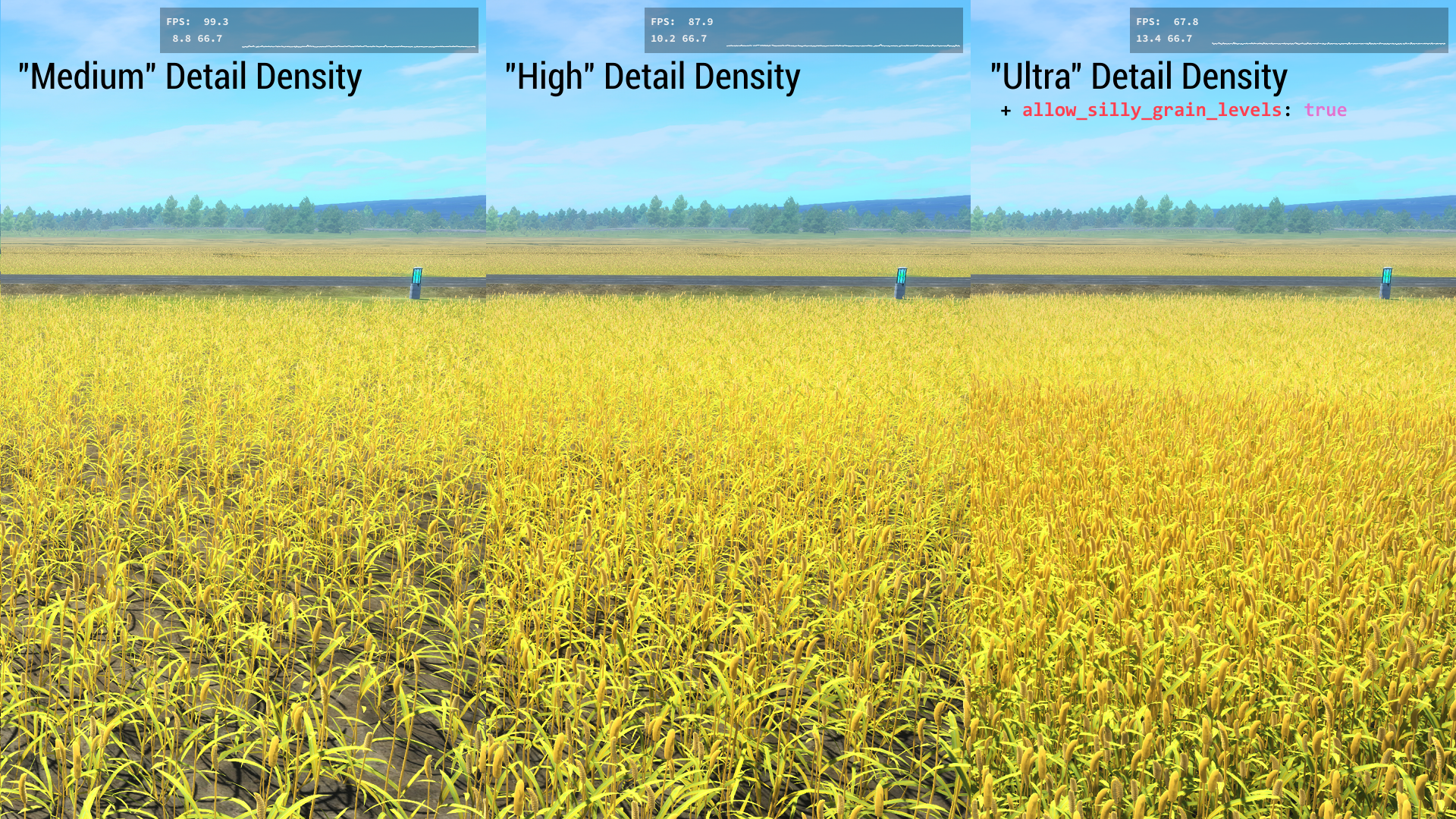
Note that the comparison above is from a camera angle that you cannot even achieve in-game, showing the difference much more clearly than it could actually be observed by a player. To prevent "Ultra" detail density from tanking performance here needlessly, this one particular instance of foliage is special-cased in the code, capping the setting to the equivalent of "High".
Note, however, that there is an escape hatch: you can manually edit the settings file to set the option allow_silly_grain_levels to true. There is absolutely no reason to do this.
Supporting Old Hardware
Particularly in the current hardware market, it is even more important to support not just the latest and greatest, but any hardware that can reasonably run a given game. This is one of the reasons why our ports support Windows 10, and will continue to do so while at all feasible.
One of our testers uses an Nvidia GTX Titan GPU. This was a very high-end graphics card, but it's also from an architecture declared end-of-life by Nvidia, and released in 2013, ~13 years ago. Nonetheless, in principle it is sufficiently fast to play this game, but it was crashing on startup.
It required quite a lot of in-depth debugging, which was made more difficult by not having any comparable hardware at hand, but ultimately I figured out that some of the rendering passes of the game depend on the TypedUAVLoadAdditionalFormats feature, which is present on basically every modern GPU but absent on that particular generation of hardware.
Long story short: the release version of Trails beyond the Horizon includes an alternative fall-back path for that functionality, which is automatically chosen on hardware that does not support this particular feature. So, if you planned on playing the game on a 13-year-old high-end GPU: enjoy, this one's for you!
Conclusion
I could continue to talk about various smaller and larger things we did for this release for hours, but I believe this post suffices to paint a picture of the level of dedication and attention to detail that are the hallmarks of our ports.
I do very much hope that everyone who decides to buy Trails beyond the Horizon enjoys the game, and perhaps benefits from at least some of this work. As always, this would not have been possible without the awesome team here at PH3, or the support of our fantastic beta testers.
Cheers,
Peter "Durante" Thoman, CTO, PH3
