“Ratatan”Development Diary #9: 30 Days on Kickstarter
In our previous post, we shared the process of creating our Kickstarter page and video, as well as the excitement on launch day.
This time, we’ll be looking back at the first 30 days since the Kickstarter campaign went live.
Launching the Kickstarter page isn’t the end of the story.
How do you nurture a project within the limited timeframe of 30 days?
In this post, we’ll look back on this 30-day journey, using actual data from “Ratatan” as a reference.
There is a reason for setting a 30-day timeframe
On Kickstarter, you are free to set the campaign duration anywhere between 1 and 60 days.
However, Kickstarter actually recommends setting it to 30 days or less.
The reason is very simple: a limited timeframe creates a sense of urgency— ‘support us now’— which in turn increases the chances of success.
We followed this principle and set our campaign to run for 30 days.
Having experienced this first-hand, we have come to deeply appreciate just how ingeniously the 30-day duration has been designed.
Kickstarter consists of ‘two peaks’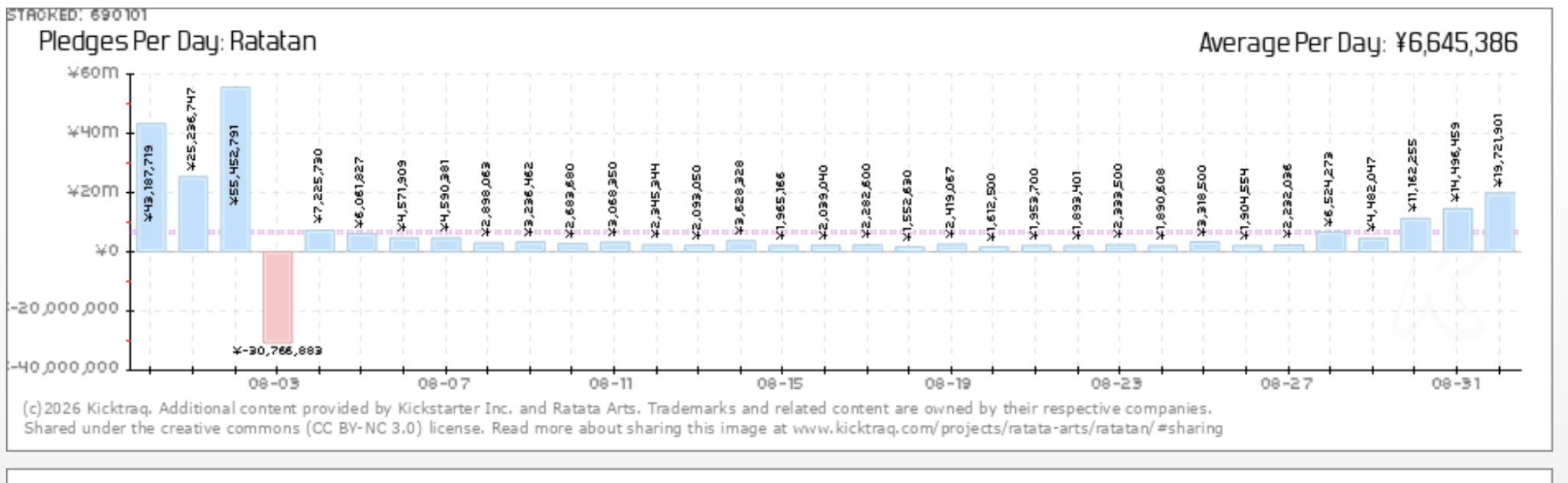
First, let’s look at the trend chart for funding amounts.
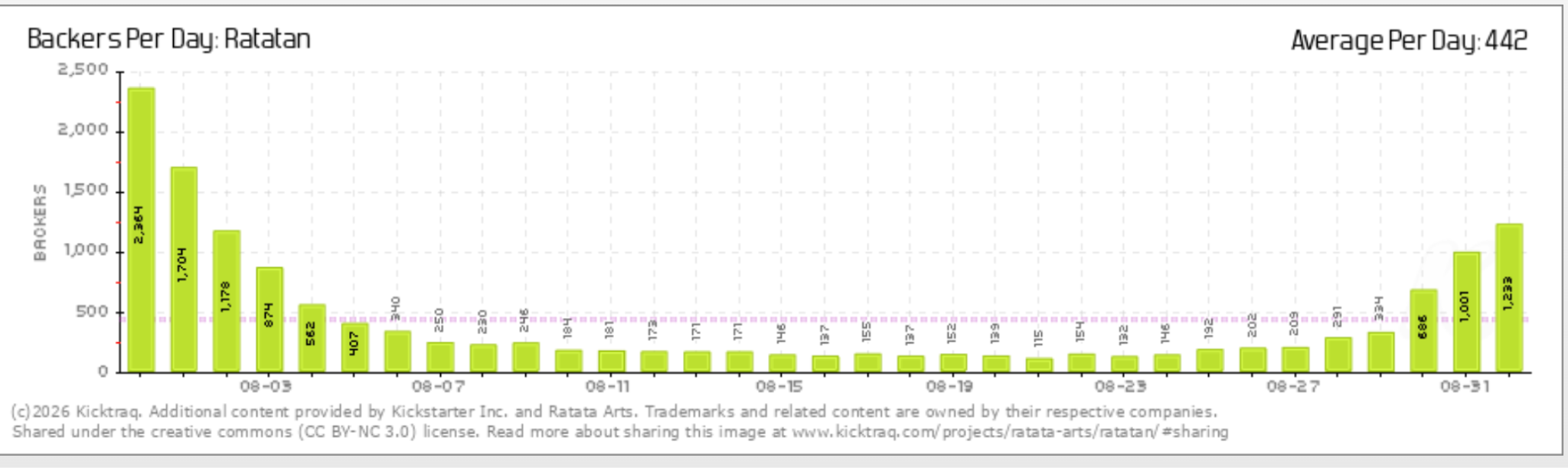
In the first few days, there is a massive peak.
This is because backers who have been waiting for the campaign to go live rush in as soon as it does.
Subsequently, the mid-phase enters a relatively stable trend.
At first glance, it may seem as though nothing much is happening during this period; however, as the campaign nears its conclusion, those who have been sitting on the fence and weighing up their options make their final decisions, leading to a second major peak.
The trend of a Kickstarter campaign is precisely defined by these two peaks: the ‘beginning’ and the ‘end’.
The middle phase is not a ‘downtime where nothing happens’
So, does that mean we can just sit back and do nothing during the middle phase?
Of course not.
We’ve always viewed Kickstarter as a 30-day online campaign:
Publishing updates
Adding stretch goals
Releasing new GIFs and videos
Replying to messages in the comments section
We place great importance on sharing updates with our backers and allowing everyone to enjoy the project’s progress together.
This continuous build-up ultimately succeeded in keeping many people highly engaged with the project throughout those 30 days.
We have come to realise that the focus of the 30 days lies not only at the beginning and end; ‘how to navigate the middle’ is equally crucial.
Setting the End Goal for 30 Days’ Time
On Kickstarter, as well as thinking about how to run the campaign over those 30 days, it is also extremely important to consider ‘what we want to present to players at the end of the 30 days’.
We planned to hold a ‘closing livestream’ on the final day of the campaign.
The aim of that livestream was to demonstrate a playable demo of “Ratatan” live on air.
In other words, we also set ‘completing a playable game prototype by that date’ as a target for the development team.
As a result, before the campaign ended, we successfully produced a prototype supporting four-player co-op gameplay.
Looking back now, that moment actually marked the official completion of “Ratatan”s first game prototype.
Kickstarter is not merely about raising funds; for the development team, it is also a clear milestone requiring us to ‘reach this stage within 30 days’.
Where do these backers come from?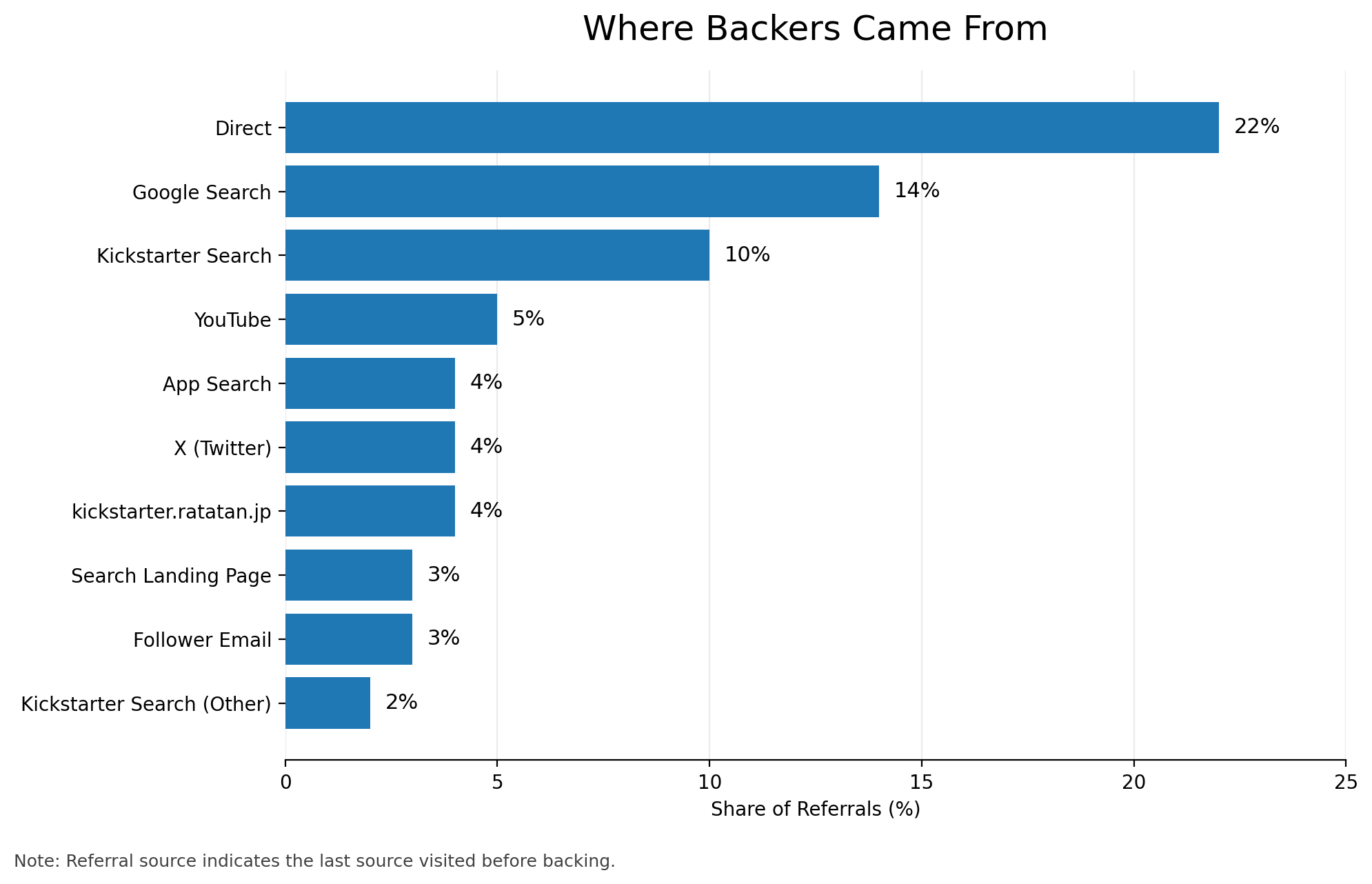
Kickstarter is not a platform where simply publishing a page will automatically attract sufficient traffic.
A look at the actual traffic sources reveals some very interesting results:
Direct traffic: ~ 22% (the highest proportion)
Google Search: ~ 14%
Kickstarter internal search: ~ 10%
YouTube: ~ 5%
X (formerly Twitter): ~ 4%
These figures do not imply that ‘only 4 %of people discovered this game on X’.
This simply represents the source URL that players were on right before supporting us.
In reality, many people first saw “Ratatan” on social media, before subsequently searching for it on Google or within Kickstarter and visiting the page.
A closer look at the data reveals that the project’s reach was by no means driven by a single medium.
It was the interplay of multiple channels— including Google searches, videos, media coverage and exposure on the Kickstarter platform— that brought “Ratatan” to the attention of a wider audience.
Project We Love
Kickstarter has a scheme called ‘Project We Love’, which is a badge awarded by the platform’s staff to projects that have attracted significant attention.
We were fortunate enough to be selected during the campaign.
This gave us the opportunity to be featured on the Kickstarter website, providing a chance for more people to learn about our project.
On Kickstarter, in addition to disseminating information externally, ‘how to be discovered on the Kickstarter platform’ is also one of the most crucial factors.
Receiving support from all over the world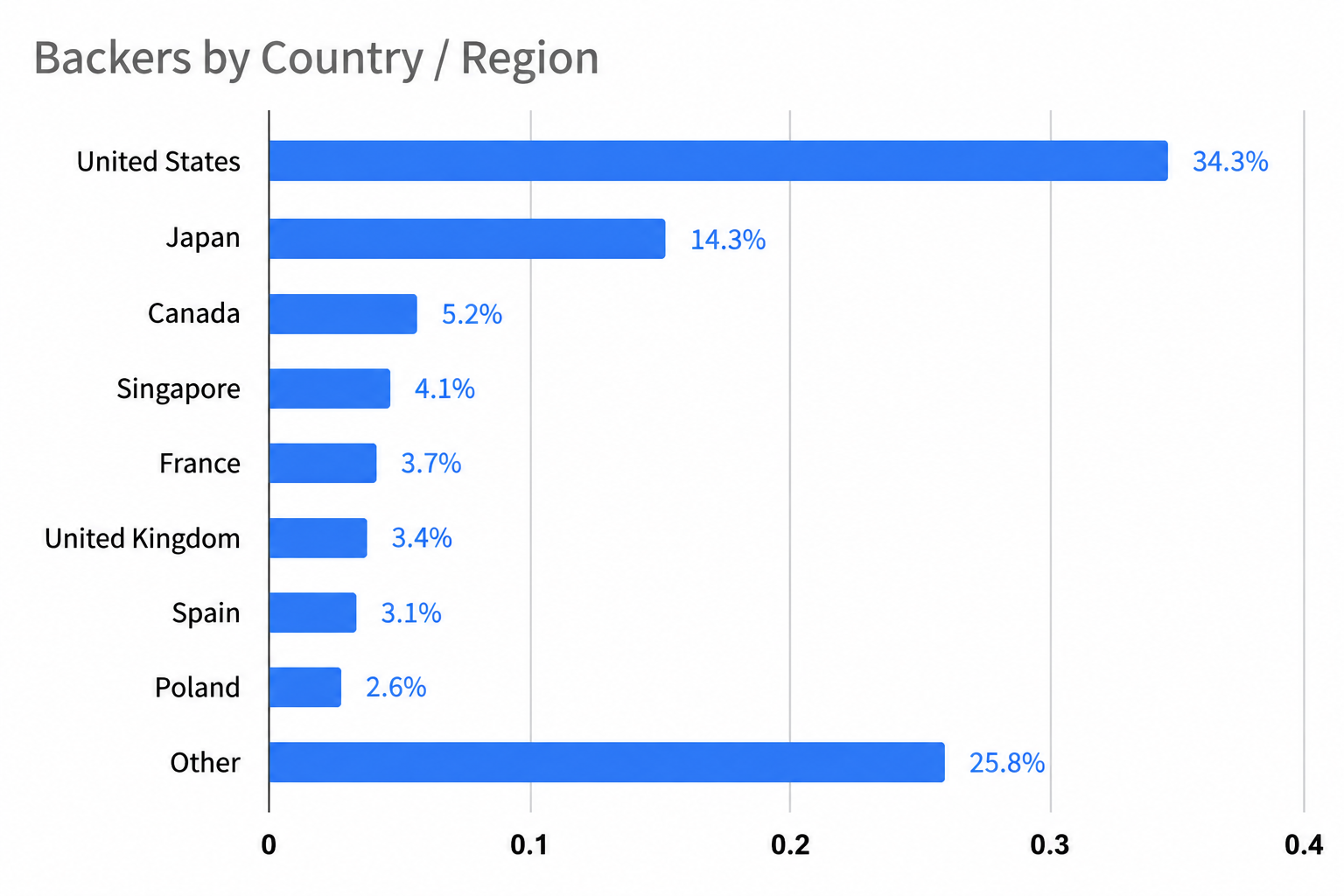
After the Kickstarter campaign ended, we were astonished when we looked back at the backing figures from each country.
Including Japan, we truly received support from all corners of the globe.
In addition to the enthusiastic response from within Japan itself, the level of support from overseas— particularly in North America and Europe— far exceeded our expectations.
This was the first time we truly felt, through concrete data, the reality of the goal we had set at the outset of the project: ‘to target the global market’.
Which backer reward option is the most popular?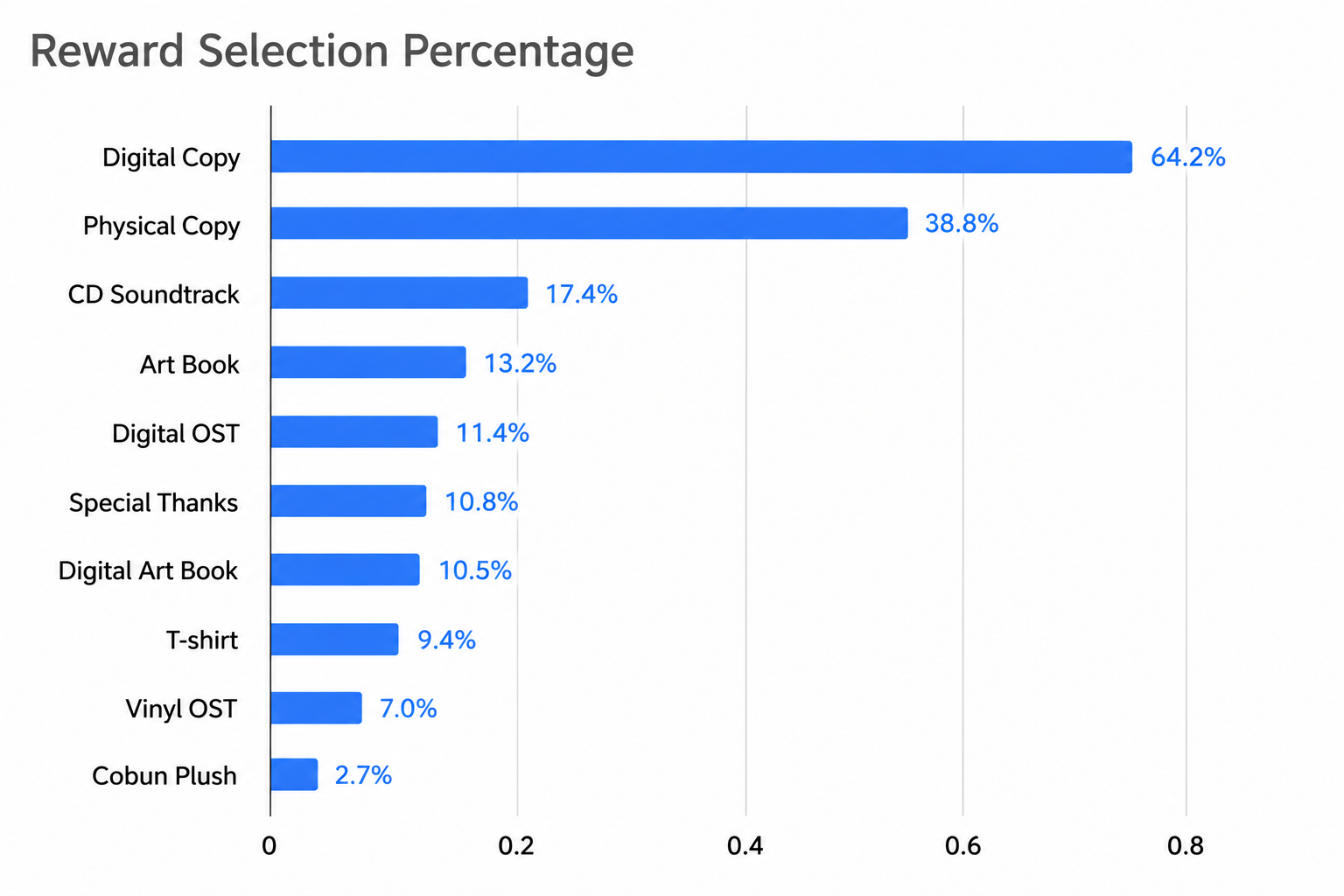
It's also interesting to look at the breakdown of each backer reward option.
Naturally, the digital version was the most popular choice, but a great many backers also opted for the physical copy, the soundtrack and the art book.
We are delighted to see that people are not merely interested in playing the game, but also have a keen interest in the music, artwork and physical collectables of “Ratatan” as a whole.
What the data reveals
Looking back over these 30 days, we fully understand why Kickstarter recommends a 30-day campaign duration.
There was tremendous momentum at the start, followed by another peak at the end; and in between, we shared the project’s progress with our backers and journeyed through those 30 days together.
Kickstarter is by no means merely a fundraising platform; it is a live event where, over the course of 30 days, we nurture the project together with our supporters.
At the same time, this requires the development team to adopt a strategic perspective on ‘how to structure these 30 days’.
It is precisely because we are now able to review the data that we have come to appreciate the ingenuity of this design even more deeply.
Preview of the Next Episode
And so, the Kickstarter campaign came to a successful close, and we received far more support than we could ever have hoped for.
However, what we truly gained was by no means limited to funding alone.
In the next episode, we’ll be discussing the legacy that Kickstarter has left for “Ratatan”, as well as the responsibilities we must now shoulder.
Stay tuned!