Hello.
Three Kingdoms Classic 1.4.0, the Red Cliffs update, is live. Its centerpiece is a new battle type: the river battle.
River battles are fought with fleets on the rivers and lakes of the Yangtze basin. A fleet commander cannot steer dozens of ships moment to moment, and river battles are built around that: each side plans three commands in advance, then both operations are revealed and resolved together.
To go with them, the old 209 "After the Battle of Red Cliffs" scenario has been rebuilt as 208 "The Battle of Red Cliffs." It used to open after the battle was already decided. Now you take command of the battle itself, from Cao Cao's chained fleet through Huang Gai's fire attack.
This update also brings naval specialties, optional officer deaths in battle, the Two Tigers Ploy — a stratagem that drives two other forces into war — and a rebuilt tribal information screen. Loyalty and food production, the strategic AI, sieges and pass battles, court offices, and keyboard and controller support have all been improved, and long campaigns hold together better when it comes to saving, replays, and turn progression.
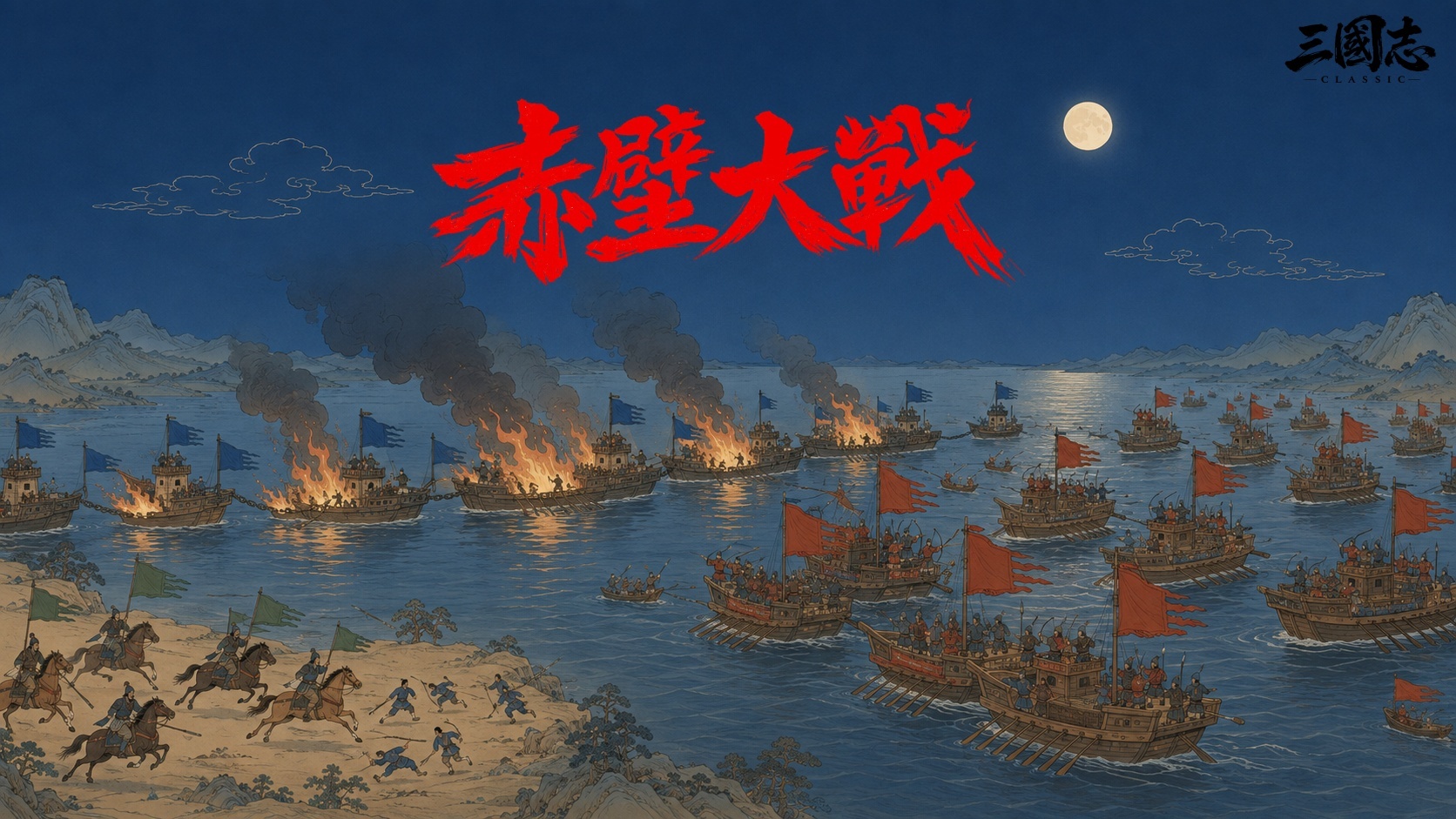
River battles
River battles break out across the waters of the Yangtze basin: Red Cliffs, Ruxukou, Xiakou, Poyang Lake, Dongting Lake, the Han River, the Yangtze, Lake Tai, and the Xiang-Gan waters.
Every operation is built from three command cards chosen ahead of time. Both sides reveal their operations at once, and the cards resolve in the order you set them as the battle develops.
Commands come in three roles.
Fleet Deployment: sets your formation, which changes your attack power, your defense, and how you answer the enemy's blows.
Maneuvers: take the channel or pull the enemy out of position to set up the attack that follows.
Attacks: strike the enemy fleet with whatever your formation and maneuvers have prepared.
Fleets can hold four formations: Massed Vanguard, Double Wings, Dispersed Line, and Linked Ships. Maneuvers are Feigned Retreat, Seize the Channel, and Fire Attack Prep; attacks are Harassing Volley and Ram Assault.
Your formation decides how hard you hit and how well you hold, and the same attack can end very differently depending on the maneuver that came before it.
When an operational mark — a lure that landed, control of the channel, a readied fire attack — lines up with the right formation, a basic command is promoted into something stronger. Ten promotions are in: Concentrated Volley, Wing Crossfire, Baited Volley, Rapid Counter, Center Counteroffensive, Reversal Envelopment, Flank Strike, Death-defying Assault, Fire Ship Assault, and Fire Arrows.
Naval specialties
Three tiers of naval specialty arrive with river battles, given to the commanders the histories actually put on the water.
Naval Drill: raises river-battle attack power when the officer serves as commander or deputy, and steadily raises the naval drill of any river-capable city where they are stationed.
Naval Command: raises normal and surprise attack power further, adds defense to Fleet Deployment, and lifts both the pace and the ceiling of a city's naval drill.
Grand Admiral: the largest gains to attack power, morale damage dealt, and Fleet Deployment defense. As overall commander, the opening won by Fire Attack Prep also holds longer.
An officer with Grand Admiral leading the fleet can scout one of the enemy's prepared cards, once per operation. Knowing a single card is often enough to rebuild your formation, maneuver, and attack order around it. Zhou Yu, Cheng Pu, Lü Meng, and Wang Jun carry this specialty.
Weather and fleet condition
Wind direction, rain, fire, fleet strength, and whether ships are chained together all feed into fire attacks and combat results. Launch a fire attack into a headwind and the flames can blow back through your own fleet.
River battles also have their own status screen, the fleet situation panel. It shows both fleets' formations and positions, the operational marks currently in play, chained and burning states, wind and weather, and the fleet strength and naval drill gauges. Command cards, promotion effects, river-battle victory and defeat art, and river-battle markers on the strategic map are all in as well.
River battles have their own battle music. Whatever the site or the scenario, a river battle always switches to that track instead of the land-battle themes, so a fleet action on the Yangtze sounds unmistakably its own.
River-capable cities build up naval drill and fleet condition separately. Officers with naval specialties raise their city's drill every month, and damage taken in one river battle carries into the fleet strength you bring to the next. Both values are visible on the river-battle screen and in the city panel, so along the Yangtze you now manage your fleets as carefully as your troops and provisions.
Troops that march out carry the naval drill and fleet strength of the city they left. The same army can be a very different fleet depending on which port it sailed from.
Fleet Maintenance, a new military command, repairs damaged fleets immediately for gold. Fleets do recover a little each month on their own, but after a hard river battle that recovery takes a very long time. When the next fight cannot wait, you can pay to bring fleet strength back up at once.
Maintenance is handled in bulk. Pick the cities you want repaired and you will see each city's recovery, its cost, and the total before you commit.
Available in your own river-capable cities, once per city per month.
A single repair restores up to 15 fleet strength.
Each point of fleet strength costs 50 gold, so a full repair costs 750.
Cities already at full fleet strength, or with a battle in progress, cannot be repaired.
AI forces follow the same rules. They repair threatened and frontline cities first and leave rear cities until the damage is serious, and they only spend when the treasury can carry it — at most two cities a month.
The river-battle AI builds its three cards from the visible situation: operational marks, formations, and fleet condition.
River battles are available in battle practice, and a new river-battle tutorial walks you through commands, formations, maneuvers, and fire attacks while following the defense at Red Cliffs. Keyboard hints stay on screen the whole time you are choosing river commands.
Sun Quan's forces gain a new force legacy built around river warfare: Jiangdong Fleet.
The Red Cliffs scenario
The 209 "After the Battle of Red Cliffs" scenario has been rebuilt as 208 "The Battle of Red Cliffs."
The old version opened on the map the battle left behind. With river battles now in the game, the start has been moved back so you can play the battle on the water yourself.
The new scenario begins in November 208, and if the conditions are met, the river battle between Cao Cao and the Liu Bei–Sun Quan alliance fires as a historical event in December 208. The opening is set up specifically for Red Cliffs:
Cao Cao's chained fleet
Huang Gai's opening fire attack
A choice of commander for the allied fleet
The historical officers on both sides, deployed for the battle
If the allies win at Red Cliffs, the campaign resolves into the fight for Nan Commandery: Sun Quan's forces take Jiangling and Cao Cao withdraws. At that point Cao Cao enters a three-month truce with each of the two allied forces.
If you are playing Liu Bei with Sun Quan under AI control, the loan of Jiangling can follow from the month after Nan Commandery is settled, once the conditions are met.
The 209 scenario is replaced by the new one and no longer appears in the scenario list. Saves already in progress on 209 still load normally.
Optional officer deaths in battle
New game setup now includes a Battle fatalities option.
Set it to On (dangerous tactics only) and officers caught in dangerous tactical clashes — in open battles, formation field battles, mountain battles, river battles, sieges, and pass battles — have a very small chance of being killed for good. The same rules apply to the player and the AI alike.
The default is Off. We recommend turning it on for games using the full officer pool.
It cannot be changed once the game has started.
It never happens to a unit with only one officer.
It is separate from lifespan, natural death, execution, historical events, and last stands.
Stratagems and diplomacy
A new stratagem, the Two Tigers Ploy, sets two other forces at each other's throats.
It sends one agent to each of the two target forces. Each court's ruler and advisors judge the plot on their own, so it can succeed with one of them or with both.
The first target must share a border with the force running the plot.
It works on two forces that are allied with each other.
If both courts fall for it, the two forces go to war and stay forcibly hostile for six months.
Even a single success sours the relationship badly.
It costs 200 gold, and an exposed agent may be detained.
If you were away from the game, or a save and load swallowed the result, stratagem outcomes are now reported once at the next sensible moment.
Stratagem specialties have been tidied up as well. The special-command specialty no longer claims it is limited to commanders and deputies, which was never true, and officers who already know a higher stratagem in a line will not relearn the lower one. Specialty details are shown alongside.
The AI no longer keeps floating the same diplomatic proposal that has already been refused under identical conditions.
Calls to surrender now turn on the ruler's character. Previously any cornered ruler responded about the same; now how open a ruler is to persuasion varies noticeably from one to the next.
Tribal factions
The tribal information screen has been rebuilt so you can read relations and the reachable invasion range on one map.
Two new tribal factions have been added: the Wuximan and the Wuhuman, along with chieftain portraits, home regions, and invasion ranges. Existing tribal portraits and the classic portrait pack have been updated too.
When you ask a tribe to invade, the size of the force they commit now scales to the strength of the city being attacked.
Envoys sent to negotiate with a tribe have a small chance of picking up that tribe's persuasion specialty along the way.
Domestic affairs and economy
City food production now scales with population. Larger cities farm considerably more, while garrison consumption is unaffected.
Balanced research catches your weakest track up in one order. It assigns every research at the lowest available stage in military or civil affairs, so no single line runs far ahead of the rest.
Bulk selection screens now offer a recommended selection that picks sensible targets for you.
Rewards: officers below a loyalty threshold.
Requisition: cities with no mobilization strain left over.
Relief: cities with low public order.
Food purchase: cities below their stockpile target.
Conscription: cities not already under repeated conscription.
Disbanding troops now works across several cities at once. Instead of entering how many to disband per city, you enter the garrison you want left behind, and everything above that is released.
The force policy screen fits all six policies on screen without scrolling.
Officers and loyalty
Loyalty recovery has been overhauled. Officers used to climb back to the loyalty cap simply by being left alone, which made managing your people close to unnecessary.
Passive recovery now applies only to officers with high honor or a personal bond with the ruler.
The bonus for a well-suited assignment follows the same rule and no longer stacks month after month.
Poorly matched assignments still never reduce loyalty.
Officers who used to be bunched up at the top of the loyalty range now spread across the middle, which gives rewards and court appointments real weight. The safeguards against a force collapsing and the limits on defection frequency are unchanged, so nobody walks out en masse overnight.
Officers with high honor or a strong bond with their ruler now resign rather than revolt when discontent boils over.
Captured officers who join your force keep the merit they had already earned.
The city officer list is now sorted the way you actually read it: ruler, the three city offices, prisoners, and unaffiliated officers first, then everyone else by merit, with loyalty grade and a signature specialty on each row.
Officer detail screens have an action menu, wired for keyboard and controller.
Cities with rumors are shown first in officer search recommendations.
City pickers are sorted by name, and officer search now weighs officer names over incidental details. The list of targets for a discord plot can be sorted by chance of success.
Court offices
Two tier-3 civil offices have been added: Director of Agricultural Colonies and Commissioner of Salt.
The Grand Tutor, Grand Preceptor, and Grand Guardian now rank above the Three Excellencies, and duplicated office information has been cleaned up.
Appointment rules now allow moves to another office of the same rank, and promotion into a higher office through enfeoffment.
When an advisor reports that an officer is waiting for an office, the report now names the office to grant and lets you grant it on the spot.
Choosing "later" on an office discontent notice actually defers it now.
Custom officers
Custom officers can now take non-unique A- and S-rank specialties when their stats qualify. B, A, and S tiers unlock in turn as the stat total rises, and the one-specialty-per-officer limit still stands.
Enter the name of a historical officer and that officer's unique specialty becomes available. Change the name and the unlock goes away with it.
The three naval specialties are reserved for historical officers and cannot be chosen for custom ones.
Wording around underage custom officers has been fixed.
Strategic AI
Cautious, balanced, and aggressive AI have each been pushed one step further toward offense, so long campaigns no longer settle into permanent standoffs. Over a 100-turn observation, each stance now eliminates rivals about one tier faster than before, and existing campaigns may feel different as a result. The chaotic stance is unchanged.
The AI now concentrates troops and officers on its main front instead of scattering small attacks across the map.
It disbands surplus garrisons in rear cities it cannot afford to maintain, returning them to the manpower pool, and fills empty city garrisons when its offensives leave room to do so.
Hopeless attacks are called off before departure, and forces that do march out leave a minimum defense behind in the city they came from. The AI is also less prone to throwing itself into a revenge attack straight after a defeat.
AI city administrators are now assigned by what each officer is actually best at.
Sieges, pass battles, and combat balance
Troop allocation has been removed from sieges. There is no longer a step for splitting troops between command, engineers, and watch, or between walls, sorties, and ramparts — the battle runs on commands and formations.
The siege AI presses a numerical advantage before the gate falls more decisively than before. Defender resistance and the intensity of fighting after a breach have been retuned, and per-stage damage is now capped so siege phases cannot run away.
Passes now come in three defensive tiers, so how hard a pass is to force and how much it favors the defender vary from one to the next.
Troops actually engaged on a narrow pass front are now separated from the reserves behind them. A large army no longer piles into a narrow frontage all at once; as the front line wears down, reserves rotate in.
When a pass's durability reaches zero, the pass battle ends without further street fighting. Outer passes that shield a city — Yangping, Hulao, Tong, and Wuguan — do not hand over the city when they fall; the fight continues on the same front as a siege. Jiange remains its own objective and is still resolved as a city capture.
Sieges and pass battles now open in the formation your advisor recommends.
Formation advisor predictions, strength evaluation when reinforcements join, destruction checks for siege engine units, and per-stage siege damage caps have all been adjusted.
Word of an ally's automatic relief force now arrives when the battle begins rather than after it ends.
Flanking attacks now resolve detection and the defensive decision on arrival rather than at departure.
Battle logs keep only the most recent engagement expanded, so you can read the current state at a glance even in long battles.
Scenarios and officer data
Force troop counts in the Guandu scenario, and Liu Bei's garrisons in particular, have been rebalanced.
Chen Dao and Liu Yan now start in Liu Bei's service at Guandu.
Yan Liang's and Wen Chou's death years, a name rendering for Hua Xin, and several other officer entries have been corrected.
Officers historically already in service are no longer hidden by the age filter at scenario start.
Fixed an issue where a current owner reserved troops and resources ahead of time for officers who only appear later.
Debut years and starting allegiances for hidden officers have been brought in line with the historical record.
Chen Gong has been given a discord specialty.
Map display
Settings now offer two map display modes: Map only and Background + map.
New games and saves migrated to this version default to Map only. If you prefer the strategic map background, switch to Background + map in settings.
Keyboard and controller
Scenario, force, and option selection in a new game can now be completed entirely with a keyboard or controller.
In stepped dialogs, Tab cycles between the list and the buttons at the bottom.
Focus movement and bottom-button wiring have been improved in battle commands, bulk orders, and the reward, personnel, and diplomacy screens.
Keyboard hints stay visible throughout river-battle commands and the river-battle tutorial.
Steam Deck input support is now a proper configuration, with a more usable on-screen keyboard and better legibility for small text.
Saving, replays, and stability
Round execution is now stored as explicit progress stages, resume points, and outcomes.
If turn progression starts looping abnormally, the game stops safely and offers a recovery path: try again, or return to the strategic map.
Fixed a hang when ending a turn after loading a save taken mid-round, and another during replay writing right after a battle.
Turn-start notices, succession decisions, force collapses, and attack warnings now appear exactly once, at the correct boundary.
Starting a new campaign immediately creates the first save file and replay baseline.
The replay list is now built from record summaries alone, which cuts the time it takes to open in long campaigns. This also fixes save loading being queued behind replay list construction in the start menu.
Duplicate recent events and battle summaries have been removed, and a previous turn's start notice no longer reappears after the month has already passed.
Save compatibility
Saves move to schema 34 and replays to format 8. Files re-saved in the new format cannot be opened by older builds, including 1.3.2+2. If there is any chance you will roll back, keep your original saves and automatic backups before updating.
Platform, audio, and achievements
Reduced music restarting from the top or stuttering when the background track changes on Windows.
Added dedicated river-battle music, which plays whenever a river battle begins.
Turn-start chimes have been rebalanced so they are not buried under the music.
Fixed Steam achievements failing to sync on macOS.
Achievements missed earlier can now be recovered from the evidence left in your saves and replays.
In closing
This update was about bringing a new kind of battle into the game and letting you experience Red Cliffs as the battle itself rather than as the situation it left behind. Loyalty, food production, the strategic AI, pass battles, and the save and replay structure were reworked alongside it so that long campaigns run more steadily and with more happening in them.
If you have been enjoying the game, please consider leaving a Steam review. Your feedback genuinely shapes what we work on next.
Thanks for playing, and for telling us what you think.
