Overview of the Patches
[p align="justify"]Our first major update, First Frost, focused on both the simulation and the overall player experience. We tackled several long-standing issues, like, for example, the death waves. We also rebalanced bicycle usage, improved nighttime visibility, updated weather and fog systems, and introduced the Color Customization tool, which gave you a first taste of customizing the appearance of your cities. Alongside these, we updated the UI, improved the landscaping tools such as terraforming, and gave you more freedom with tree placement.[p align="justify"]The updates that followed continued that work across multiple areas of the game. In the Anniversary Update, we introduced one of the community's most requested features: the ability to toggle road zoning, giving players greater control over how and where development occurs. We also added our first new asset, the Iceflake Arena, expanded gameplay options, and introduced the in-game Encyclopedia, making it easier for both new and experienced players to find information about the game's systems.[p align="justify"]As spring progressed, our focus shifted toward improving city management and player control. Our fourth patch, Spring Cleaning, introduced the Historic Building option, allowing players to preserve buildings they wanted to keep from being upgraded. We also gave more freedom to customize your UI by adding transparency and scaling options, which were both suggested by you immediately after the release of the new UI. We also continued working together with the Paradox Mods team, giving better mod management and download systems.[p align="justify"]Morning Dew continued our work on quality-of-life improvements. We expanded asset filtering options, improved several creator-focused workflows, refined tool behavior, and addressed visual issues affecting shadow rendering. While smaller in scope than some previous updates, Morning Dew focused on smoothing out everyday city-building and addressing issues reported by the community.[p align="justify"]Most recently, we had Summer Solstice, which focused on improving both the visual quality of the game and some of its underlying simulation systems. This patch introduced a complete rework of terrain rendering, improved terrain shading, depth perception, and overall landscape quality. We also added terrain painting tools, which allowed you to paint and blend terrain textures directly in-game and in the Editor.[p align="justify"]Of course, all of these updates included fixes and improvements across the simulation, performance, and stability as well. For example, with Spring Cleaning, we introduced our Benchmarking tool, which marked the first steps towards making the performance of the game better for everyone. Some of these changes, like the improvements on traffic pathfinding introduced in Morning Dew, are not always immediately noticeable and might even work behind the scenes, but they still have an effect on the overall performance and simulation.Statistics
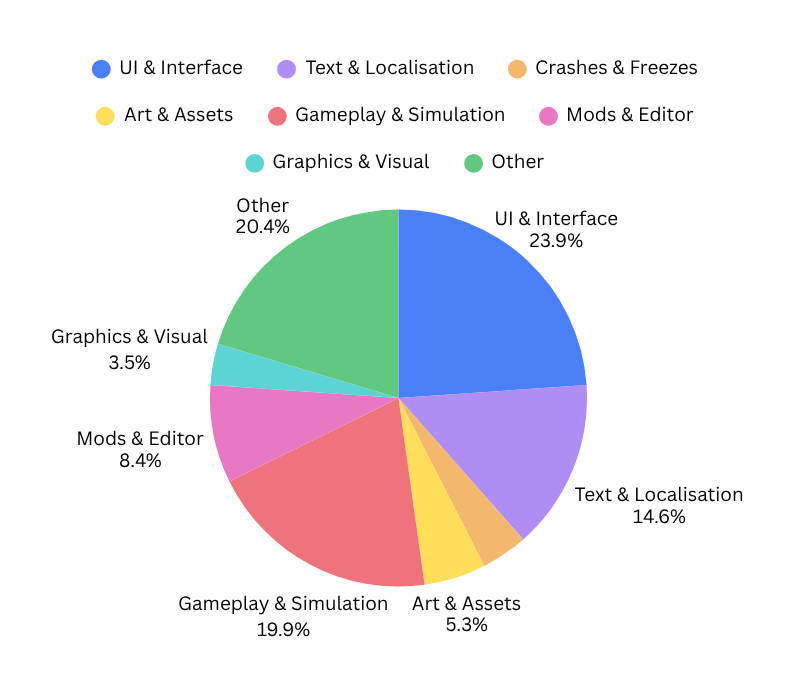
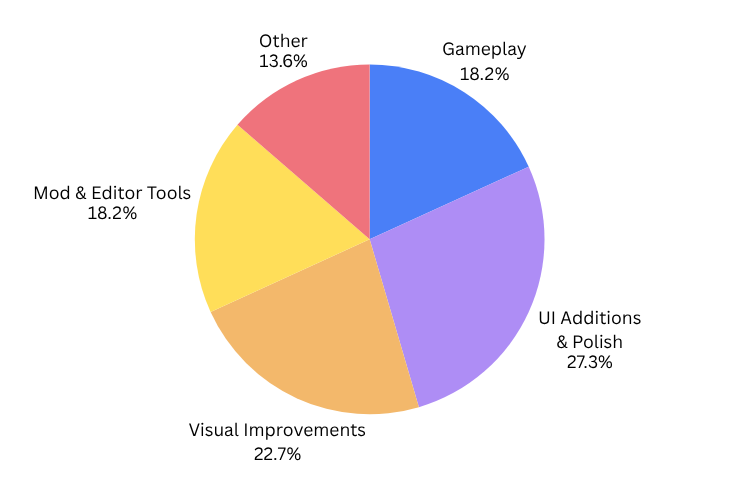
[p align="justify"]Since we’re all here and we love our numbers and charts, let’s look at some statistics, shall we! Starting from January up until now, we have fixed 200+ bugs and added 40+ new features and improvements! To elaborate, we wanted to show you a chart on how these bug fixes and improvements have been divided between different aspects of the game.
What's next?
[p align="justify"]As the summer is slowly reaching its zenith and coming to an end here in Finland, we are already working toward the next updates. While our next patch will not be as content-heavy, it will still include bug fixes and a few tweaks to the simulation. As per usual, we will get into all the details about the next update in a future City Corner dedicated to the patch itself! Looking into the horizon, we have also been working on our first DLC - we will tell you more about it at a later date when we are ready![p align="justify"]We’re so excited for you to be along for the journey; here’s to another 6 months, 1 year, and further into the future!