Hi everyone,
We hope you’re all enjoying the summer so far! Today we’ll be talking more about Kaiserpunk’s AI. We touched on this and the status of the current AI in Dev Log 18, but today we’ll go into more detail how the AI has been rehauled for the Warfare update and what the fruits of that labor will be. As usual, I’m Danijel, the Lead Designer for Kaiserpunk and I’ll take you through it.
In Dev Log 18 I mostly covered how the current AI is causing quite a few headaches and that the intention with the new one was to provide more personality, readable behavior and be far easier to adjust. So let’s talk about what that actually means and what it will look like for you when you’re playing the game with the new Warfare update.
Personality over computation
The AI doesn't need an infinite ability to look ahead to feel alive. It needs recognizable behavior. When a warmonger faction builds up troops on your border, you should think "oh no, they're coming for me" - because that's exactly what they're doing, and it's exactly what that faction would do.
Same rules, different weights
The AI uses the exact same combat systems as you - battlefronts, divisions, supplies, directives. It doesn't get secret bonuses or any hidden mechanics. Difficulty scaling adjusts how well it plays and how efficiently it produces its resources and units, not what tools it has access to. When you blockade an AI's coast, their supply actually drops. When you bomb their supply depot (formerly Logistics center), their fronts actually weaken. Your strategic actions have real, visible consequences.
Readable from the outside
You should be able to look at an AI faction and understand what it's doing. An aggressive faction builds armies and picks fights. A diplomatic faction proposes trade deals and avoids confrontation. No more "why did the AI do that?" moments.
How It Actually Works
The entire old system that contained 16 different managers, an async pipeline, and a multi-frame processing is all gone. Deleted. In its place: a single unified controller that runs all decisions for all factions cleanly and predictably. No more async complexity, no multi-frame state bugs, no debugging nightmares.
Each AI faction has a personality - a set of traits that define who they are. Here’s a few examples:
Aggressiveness - How likely they are to start wars
Military Focus - How much of their output goes to their armies vs their economy
Diplomatic Openness - How willing they are to make deals
Expansion Desire - How much they value conquering new territory
Opportunism - Whether they'll choose to kick you because you're already fighting someone else
We use these traits to craft recognizable archetypes. A Warmonger faction (high aggression, high military focus, low diplomacy) behaves very differently from a Diplomat (low aggression, high openness, high alliance propensity). You'll learn to read the factions - "ah, that's the expansionist neighbor, better keep some troops on that border" - instead of being blindsided by random behavior.
The AI's economy is streamlined for consistency. Rather than running a full parallel simulation of every production chain (which is what created the chaotic behavior in the old system), each AI faction has a budget based on the regions it controls, split between military, economic, and diplomatic priorities according to its personality. This means the AI's output is always proportional to its territory. If they lose regions, they also lose power. If they gain regions they also gain power. Simple, fair, and predictable.
But - and this is crucial - your actions directly impact that output. The AI's effective strength responds to real strategic pressure:
Blockade their coast with a naval division? -25% effective output.
Bomb their Logistics Center with a strategic strike? -15% per destroyed center.
Cut their supply route by conquering a region in their path? -20% per severed connection.
Stack enough of these and you can choke an AI faction down to 20% of its normal strength. When you see their fronts weakening after your bombing campaign, that's not a coincidence - that's your strategy working, and the AI responding honestly to it. This was an important design requirement for us: If you make a smart strategic move, the AI must feel the consequences and you should be able to notice the effects. Otherwise, what's the point?
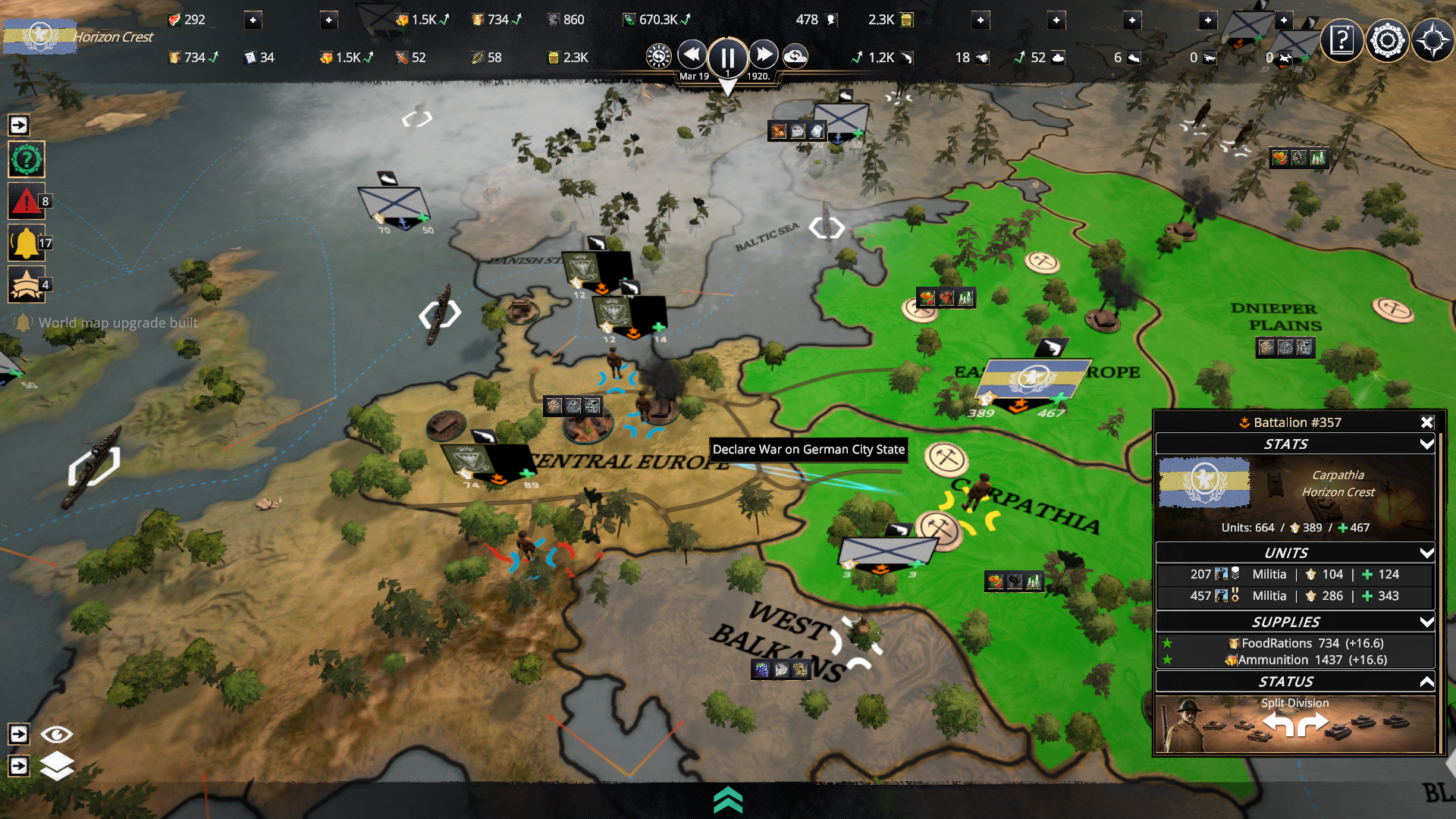 WIP Screenshot - A real question if wether I should start a war with Germany or keep them as a trading partner instead.
Difficulty and Aggressiveness: Two Separate Dials
This is one of the biggest changes, and it comes directly from listening to your feedback. In the new system, difficulty and aggressiveness are two completely independent settings, each with 5 levels. You set both when starting a game. Difficulty controls how smart and efficient the AI is. Aggressiveness controls how war-prone and expansionist the AI is - completely independently of how smart it plays.
The magic is in how these combine. Easy + Passive is the "let me build my city in peace" setting - the AI is weak and leaves you alone. You can expand at your own pace, start wars on your own terms, and never worry about a surprise declaration ruining your afternoon. Perfect for players who want the city builder experience with optional warfare on the side.
Normal + Balanced is the intended default - a fair challenge where the AI plays competently and wars happen organically.
Hard + Aggressive is for players who want to feel the pressure - a competent AI that's also actively looking for a fight.
Or maybe do a shuffle: low aggression + high difficulty? They’ll do their best to outsmart you in negotiations and adjust to whatever you’re doing, but won’t be easy on the trigger. Mind you, that doesn’t mean they won’t eagerly defend themselves.
The point is: these are separate axes because different players want different things. Some people want a hard puzzle but a peaceful world. Some people want constant warfare but winnable wars. The old system couldn't accommodate that. The new one can.
Faction Personalities You Can Actually Read
Every AI faction is built from a personality archetype that defines how they behave across all systems:
Warmongers pour resources into military production, build large staging forces on borders, and need very little provocation to declare war. But they're diplomatically stunted - they refuse most deals and rarely pursue alliances.
Defenders maintain strong militaries but almost never attack first. When you pick a fight with them you’ll likely discover they've been quietly building fortifications and entrenchment for the last 20 cycles.
Diplomats propose trade deals constantly, pursue deep alliances, and avoid confrontation. They're your best trading partners - but if you want to fight them you’ll likely have to fight their friends too.
Industrialists focus on research and economic development. They start slow but snowball - leave them alone too long and they'll be fielding higher-tier units while you're still on basics.
Expansionists are the middle ground - militarily capable and diplomatically flexible, but always eyeing the map for their next conquest. They'll trade with you happily until a juicy undefended border presents itself.
The AI also evaluates war declarations through a scoring system. It weighs its own strength versus yours, how many fronts it's already fighting on, its relationship with you, whether you're already at war with someone, and how valuable your border regions are. An aggressive faction with a strong military and an opportunistic streak will absolutely pile on when you're distracted by another war. A cautious defender won't declare war even with a 2:1 advantage unless provoked.
This means you’ll be able to predict behaviors, but not necessarily their timing. You may know that a certain neighbor will attack, you’re just not sure when. This should result in far more satisfying gameplay and challenge.
Why This Matters for Balance
Here's the thing that matters most from a pure development perspective: We can actually adjust this.
The old 16-manager system was essentially unbalanceable. Change one number and three other systems shifted in unpredictable ways. The new system is transparent - every decision has a clear formula with adjustable constants. If the AI is declaring war too often on Normal, we adjust one threshold. If it's not producing enough units on Hard, we change one multiplier. If a specific faction personality feels wrong, we can easily tweak its sliders.
More importantly, you can see the cause and effect. If we release a patch and the AI feels different, we can tell you exactly what changed and why. No more "we adjusted dozens of values across a sprawling system and hope it's better now."
This also means balance patches can be surgical. We can make the Warmonger archetype slightly less aggressive without touching the Diplomat's trade behavior. We can buff Nightmare difficulty's production without changing how often the AI declares war. Every knob is independent, every change is isolated. That's not just good for us - it means faster, more targeted updates for you.
Independent Regions: Finally Alive
Independent regions are now passive defensive entities with real teeth.
Each independent starts with a designer-set garrison that scales with the region's value - a small, poor region might have 50-100 infantry equivalent, while a large, resource-rich region could have 300-500. You can't just sneeze at an independent and take it over anymore. Conquering a medium region requires proper force composition. Taking a capital region is a serious military commitment.
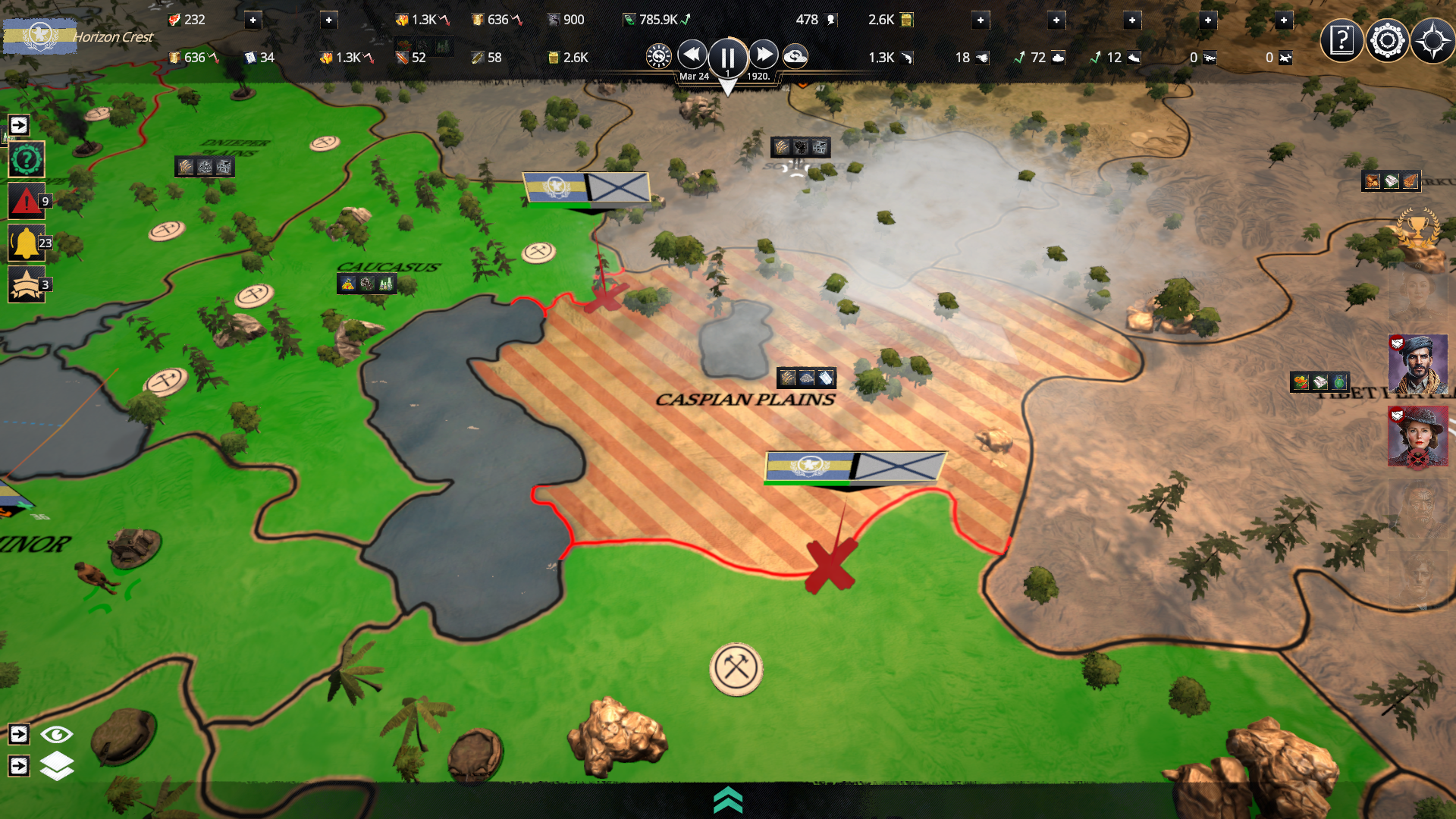 WIP Screenshot- Attacking a nearby independent region from two fronts to gain an advantage
Independent regions also grow passively over time. Every few hours (the rate scales with the aggressiveness setting), independent regions add a small batch of troops to their garrison. Leave an independent alone for too long and it becomes a tougher nut to crack. This makes the world feel more alive - borders aren't static, undefended regions don't stay undefended, and the strategic calculus of "when do I invade this independent region?" actually has a time pressure element.
On Passive aggressiveness, independents barely grow - one action every 10 days. On Extreme, they're reinforcing every day. Another way the two difficulty dials let you customize your experience. Naturally the numbers provided here are a work-in-progress and are more to illustrate the point rather than actual final values.
Moving Forward
The goal with the new AI isn't to create a chess grandmaster. It's to create opponents that feel like opponents - factions with recognizable personalities, clear motivations, and enough competence to keep you honest. We want you to look at the world map and think about your neighbors as characters with agendas, not as opaque black boxes that occasionally do things that don't make any sense to you.
We also want every player to find their sweet spot. The casual city builder who wants to wage war on their own schedule. The strategic thinker who wants a fair but firm challenge. The veteran who wants five Nightmare Warmongers on their doorstep. You'll all be able to find the setting that makes the game fun for you - and that's really what this whole overhaul is all about.
We hope you’ve enjoyed this insight into our new AI. We’re currently testing ourselves against it in our internal playtests to calibrate it further. For our next dev diary we’ll cover what it means to build a city while waging a war in the new Warfare update and how we’ve improved staying on top of things on the world map while also optimizing production chains. You can expect to see that dev log pretty soon as things are getting closer over here.
All the best,
- The Overseer Team