Hello, Commanders!
After days of forecasts, frontline reports, and nation spotlights, spoiler season is nearly at an end. Today, we close out our Oceania Storm previews with Britain and Germany, two nations whose forces adapted to some of the war's most demanding conditions and whose KARDS identities revolve around flexibility, efficiency, and sustained pressure.
These are the final card reveals before Oceania Storm arrives tomorrow. Read on for the full briefing, or check out the video report below.
https://youtu.be/-km44FRQGaE
If you missed our previous reports from the front, you can catch up here:
Oceania Storm Forecast: US, ANZAC & Weather
Oceania Storm: Japan and the Soviet Union
Britain
While Britain fought across the globe during WWII, its most significant contribution to the Pacific War came in Burma. There, the British Fourteenth Army battled through dense jungle, monsoon rains, disease, and some of the most challenging supply conditions of the war. Success depended not only on defeating the enemy, but on overcoming the environment itself.
From the setbacks of 1942 to the victories at Imphal and Kohima and the final advance toward Rangoon, British and Commonwealth forces adapted, reorganized, and eventually turned the tide. In the process, the Fourteenth Army earned its enduring nickname: the Forgotten Army.
In Oceania Storm, Britain focuses on cards that didn't start in your deck, versatile utility tools, and powerful heavy bombers capable of delivering decisive strikes. You've already seen some of Britain's reinforcements. Today, two more join the roster.
Universal Carrier
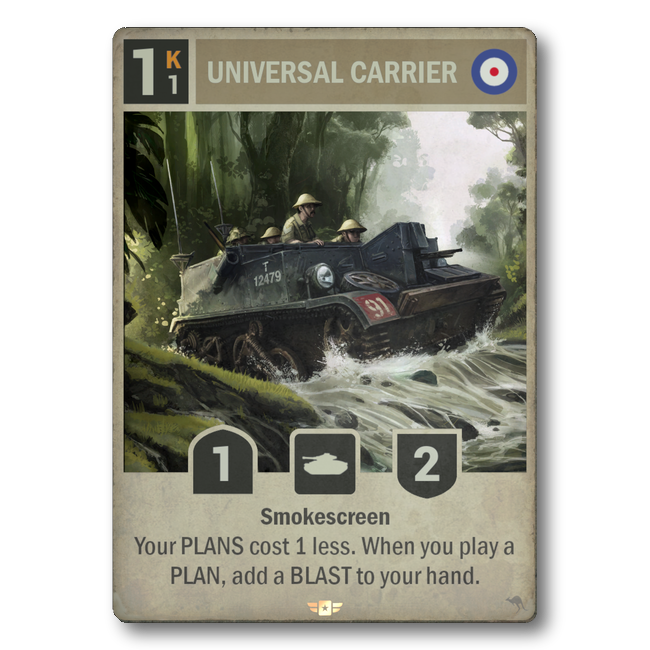
Smokescreen. Your PLANS cost 1 less. When you play a PLAN, add a BLAST to your hand.
The Universal Carrier was one of the most common British armoured vehicles of WWII, with around 113,000 units built. It was developed from earlier Bren Gun and Scout Carriers, but the Universal design introduced in 1940 gave the British Army a single flexible tracked vehicle suited for many roles. It was small, open-topped, lightly armoured, and powered by a Ford V8 engine. Its usual crew included three or four men, with space for weapons, ammunition, stores, or passengers. The carrier was not meant to be a tank. Its value came from mobility and practicality. British and Commonwealth units used it to move Bren guns, Boys anti-tank rifles, PIATs, mortars, radios, and observation teams. In infantry battalions, carrier platoons gave commanders a fast way to shift support weapons across the battlefield. Reconnaissance units also used carriers beside scout cars. The vehicle appeared in nearly every theatre, from the Western Desert to Burma and Northwest Europe. Many variants were built, including mortar carriers, artillery observation vehicles, and the Wasp flamethrower version. Its simple design made it easy to adapt, which explains why it served long after WWII.
In KARDS, Universal Carrier brings that same versatility to the battlefield. It reduces the cost of your Plans and rewards every Plan played with a Blast. Simple, reliable, and always ready for the next task.
Area Bombardment
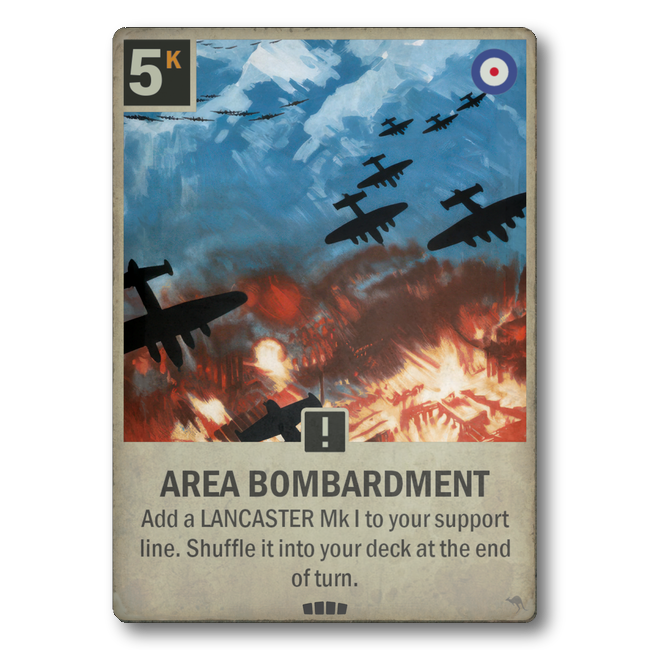
Add a LANCASTER Mk I to your support line. Shuffle it into your deck at the end of turn.
Area bombardment became a central part of RAF Bomber Command’s night war against Germany. Early hopes of striking individual factories or military targets often failed due to darkness and poor weather. The 1941 Butt Report used photographs to measure results and showed how often crews missed their aiming points. Many bombs fell far from the intended target, which pushed the RAF toward attacks on wider industrial areas rather than single buildings. This did not mean the RAF gave up trying to improve accuracy. In 1942 it created the Pathfinder Force, made up of selected crews who flew ahead of the main bomber group. Their job was to locate the target and mark it with flares and target indicators. They also received navigation systems such as Gee, Oboe, and H2S earlier than many other units. In 1943, the force was redesignated No. 8 Group, with the motto “We Guide to Strike”. The Pathfinders helped concentrate area bombardment and reduced the waste caused by scattered bombing.
In KARDS, Area Bombardment delivers a Lancaster Mk I directly to your support line before shuffling it back into your deck at the end of the turn. One heavy bomber exactly when you need it, with the possibility of another sortie later. Flexible, efficient, and capable of delivering overwhelming force at the decisive moment.
Germany
Germany had little direct role in the Pacific Theater, focusing on naval engagements and occasional raiding, but its forces fought across some of the harshest battlefields of the war, from the deserts of North Africa and the mountains of Italy to the vast, unforgiving expanses of the Eastern Front.
In Oceania Storm, Germany focuses on operating units repeatedly and extracting maximum value from Veteran units. The longer your forces remain active, the greater the pressure they can exert.
You've already seen some of Germany's new tools. Here are two more joining the campaign.
Sustained Pressure
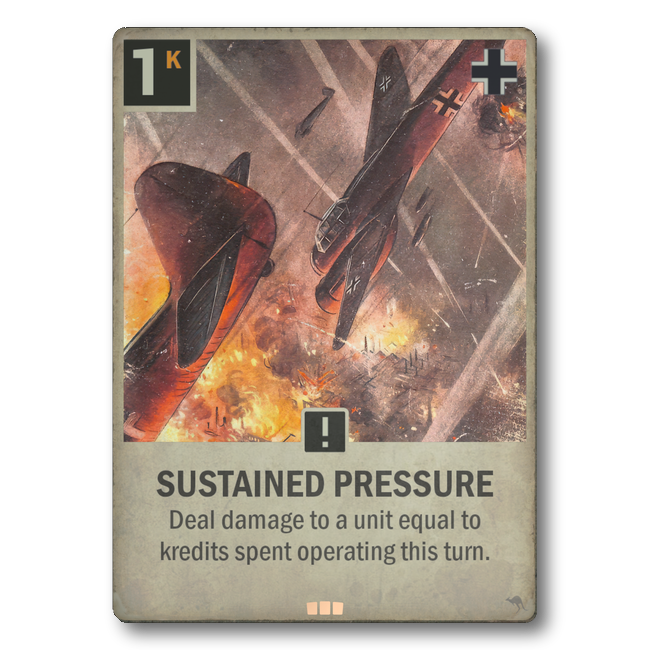
Deal damage to a unit equal to kredits spent operating this turn.
During WWII, Stalingrad was a major Soviet industrial city on the Volga, with factories, rail links, fuel stores, and river traffic that supported the front. In August 1942, Luftflotte 4, one of the primary divisions of the German Luftwaffe concentrated much of its strength there as German ground forces closed on the city. Fliegerkorps VIII was ordered to support the 6th Army and 4th Panzer Army, which saw Stalingrad as central to the wider German drive toward the Caucasus oilfields. On 23 August, German aircraft carried out one of the heaviest air attacks yet seen on the Eastern Front. Ju 87 dive bombers, Fw 190 ground attack aircraft, He 111s, and Ju 88s struck Soviet positions and then the city itself. Around 1,600 sorties were flown that day, dropping about 1,000 tons of bombs. Fires spread through factories, schools, homes, oil tanks, and docks, while smoke rose high above the Volga. The pressure did not end with the first raid. Stalingrad was bombed block by block for days, and Luftflotte 4 kept flying repeated missions against Soviet troops, airfields, river crossings, and industrial districts through the battle.
In KARDS, Sustained Pressure deals damage equal to the kredits you've spent operating units that turn. The more resources you commit to your operations, the harder it hits. Continuous, cumulative, and relentless.
Heinkel He 59
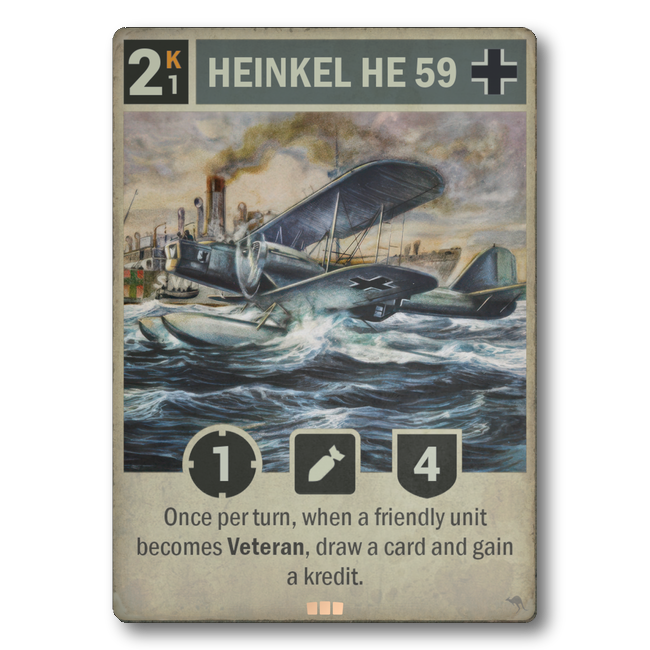
Once per turn, when a friendly unit becomes Veteran, gain a kredit and draw a card.
The Heinkel He 59 was a large twin-engine biplane floatplane built for roles forbidden to Germany when its design began in 1930. Officially presented as a civil aircraft, it had in reality been developed for the Reichsmarine as a torpedo bomber and reconnaissance aircraft. The first landplane prototype flew in 1931, but only the floatplane version went into production. A total of 142 were built. The He 59 was easy to fly, but its weak engines, short range, limited load, and light armament made it outdated by WWII. Even so, it found use in coastal reconnaissance, minelaying, torpedo training, transport, and air-sea rescue. During the early war it supported German operations in Norway and the Netherlands, then became closely linked with the Seenotstaffeln, the Luftwaffe air-sea rescue units. He 59 crews searched the Channel for downed German airmen during the Battle of Britain. British forces argued that some rescue aircraft also performed reconnaissance, making them valid targets despite their Red Cross markings. Later, in 1943, Finland later rented four He 59s for long range patrol and transport, before returning them to Germany.
In KARDS, the Heinkel He 59 supports Germany's Veteran strategy. Once per turn, whenever a friendly unit becomes Veteran, you gain a kredit and draw a card, helping keep your operations funded and your hand stocked as experienced troops continue to prove their worth.
The wait is almost over, Commanders.
Tomorrow, Oceania Storm makes landfall.
The forecasts have been issued. The reinforcements are assembled. The battle plans are drawn.
Now it's time to weather the storm.