Act 2 of Hollywood Animal, which spans up to 1965, is shaping up to be the most complex and content-rich part of the game.
Naturally, it will include a vast number of new events, scandals, characters, and large-scale storylines. Thought there was something suspicious about Joe Duvall’s death? Ever wanted to meet Arthur Gerstein’s younger brother (after all, the studio is called Gerstein Brothers)? Want to prevent the rise of spy mania in the US — or, on the contrary, help fuel it?
Act 2 will offer all that and much more. But today, we’d like to focus on systemic changes — how the core gameplay mechanics will evolve and expand, particularly those that directly affect how you make and release films.

The period covered by Act 1 clearly favored the film business. Movies were in high demand during the height of the Great Depression, throughout the New Deal years, during World War 2, and in the post-war economic boom. Most importantly, in a young and rapidly growing industry, things largely ran on momentum. Films were quick and relatively easy to produce, and talent was fairly undemanding.
Act 2 presents a radically different reality. Now, every project is a complex puzzle, requiring you to bring together a vast number of moving pieces. Getting a film across the finish line without things falling apart and successfully releasing it will feel like a true feat of heroism.
It’s not just that the average shooting period will increase (it will), or that the average shooting day will become more expensive (it will). It’s that you’ll have to account for far more variables at every stage.
New challenges arise as early as the script editor. Previously, character age was more of an abstract concept, and actor age only affected a limited number of mechanics. Now, you’ll need to define a clear age range for each role — and make sure that all characters’ ages align logically within the story. Yes, with upgrades, top-tier makeup artists can smooth over some inconsistencies, but don’t expect audiences to take a film seriously if a retiring 60-year-old police chief is played by a 23-year-old punk.

This means you’ll need to pay much closer attention to your talent roster — and they won’t make your life any easier. A new union bringing together actors, directors, and cinematographers will ban time-based contracts. At a certain point, only contracts tied to a specific number of films will remain. Meanwhile, competition for stars will become so intense that any reasonably notable professional will try to push various demands into their contracts.
Some will only agree to leading roles. Others won’t touch scripts below a certain quality level. Some will only work with award-winning directors, or have strict expectations about their co-stars. You can, of course, try to remove certain clauses using various resources (or your, ahem, special methods of persuasion), but either way, truly valuable talent can no longer be bent entirely to your will — unless your word carries REAL weight.

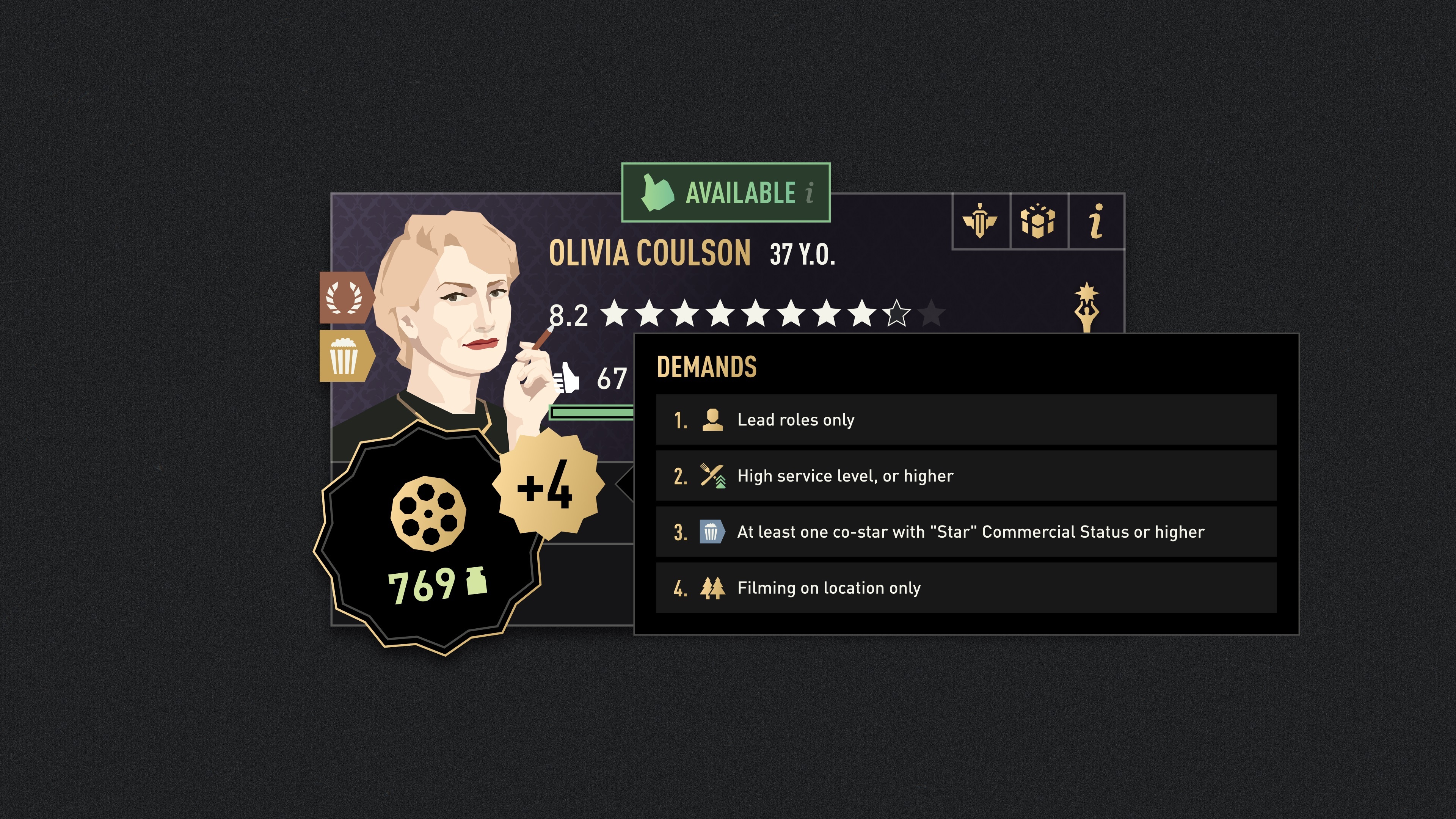
If characters sign multi-picture deals with you, they are no longer obliged to jump into your project at a moment’s notice. They may work with competitors, and you’ll have to catch openings in their often packed schedules. This also means that any production delays or deviations from the plan can lead to painful and costly consequences — unless you find a way to resolve the issue quickly. In extreme cases, an actor may even leave your set early to fulfill obligations to another project. Yes, you can negotiate exclusivity in advance, but that will require upgrades and significant resources.

Let’s say you’ve managed to sort all that out — but what if the role requires specific skills? It’s only reasonable to expect that the lead in a musical (yes, musicals are finally coming to the game!) can sing, or dance, or play instruments, or all of the above. Likewise, a western star should be able to handle firearms, ride a horse, and perhaps perform their own stunts. Actors can be trained either in your own school or through your partners, but success is never guaranteed. We’re starting with 10 types of special skills for Act 2, though that number may grow over time.
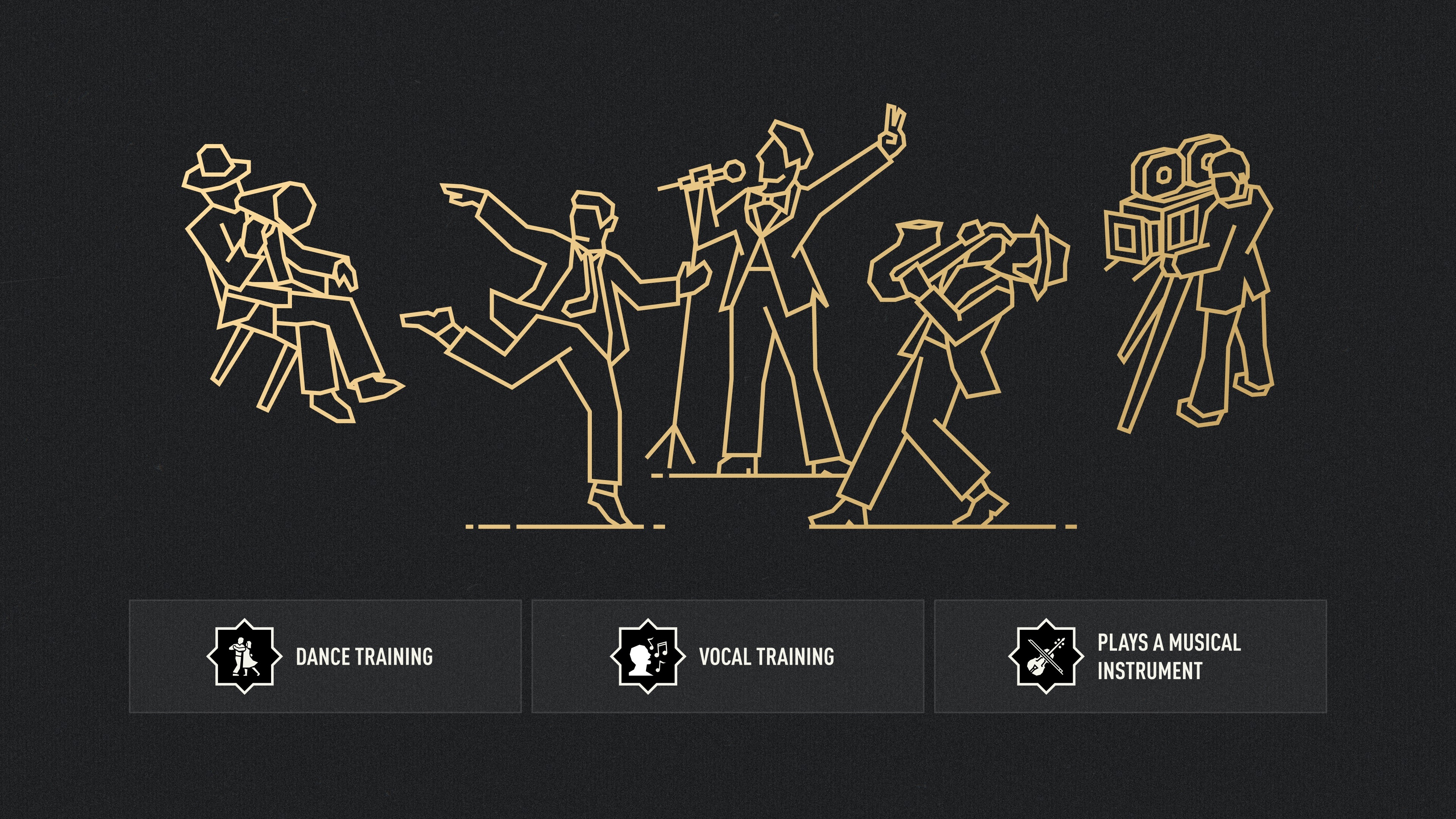
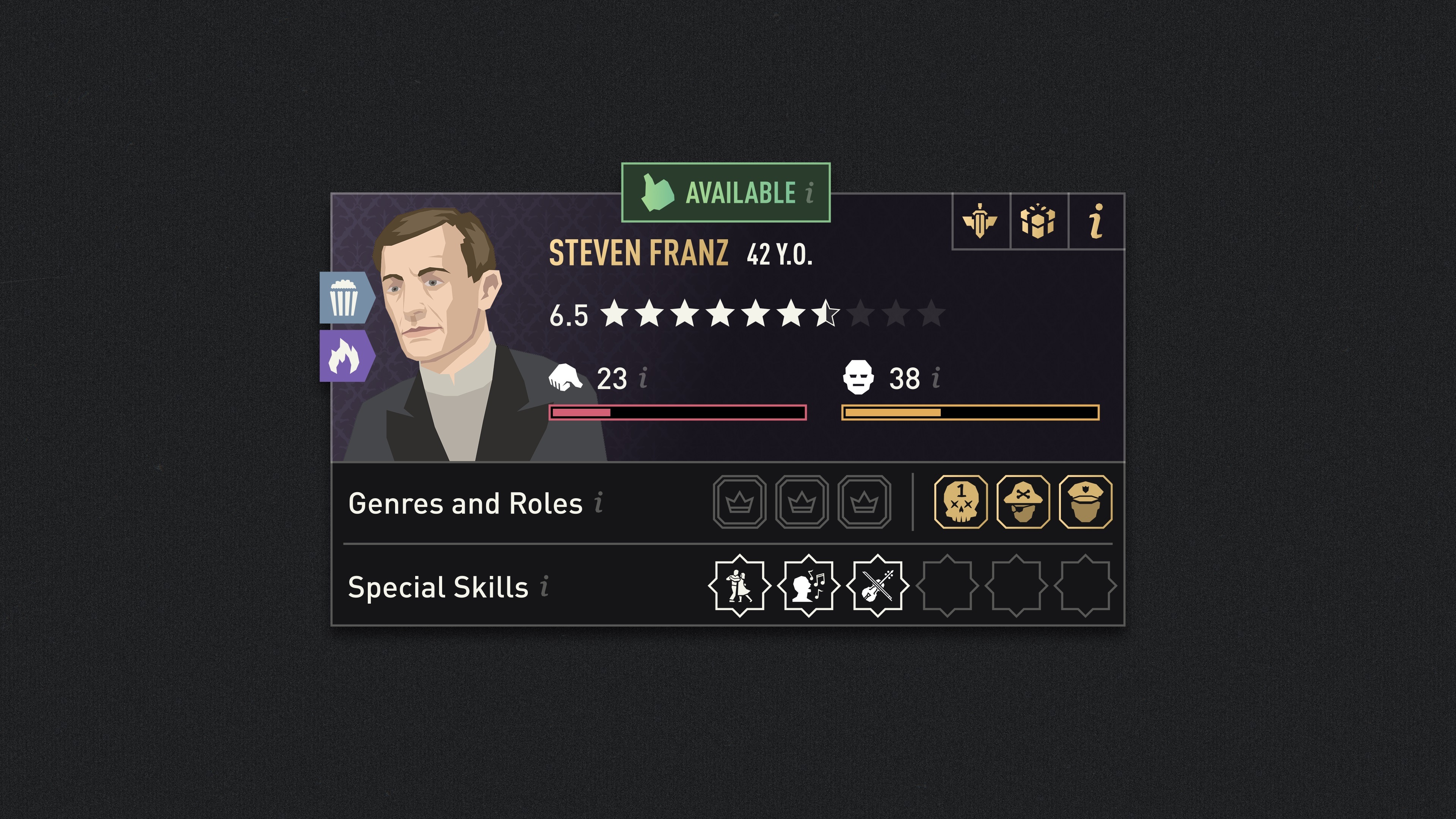
As a result, casting the right talent becomes a genuinely complex and creative challenge. You need to satisfy contract requirements, account for availability, match age ranges, and ensure the actor has the necessary skills. If you’re aiming for high-status talent, the difficulty increases dramatically.
Fortunately, you’ll now be able to develop your own stars with both commercial and artistic standing. Various achievements will gradually fill a dedicated progress bar, and you’ll be able to track this development in detail on a separate screen.

But let’s assume everything comes together. The cast and crew are assembled, pre-production and production somehow stay on schedule, and everything proceeds relatively smoothly. But is the result actually good?
That’s harder to answer now. You’ll still know the script’s quality precisely, since it remains a standalone work in a sense. But after pre-production, production, and post-production, you’ll only receive an approximate evaluation within a certain range.
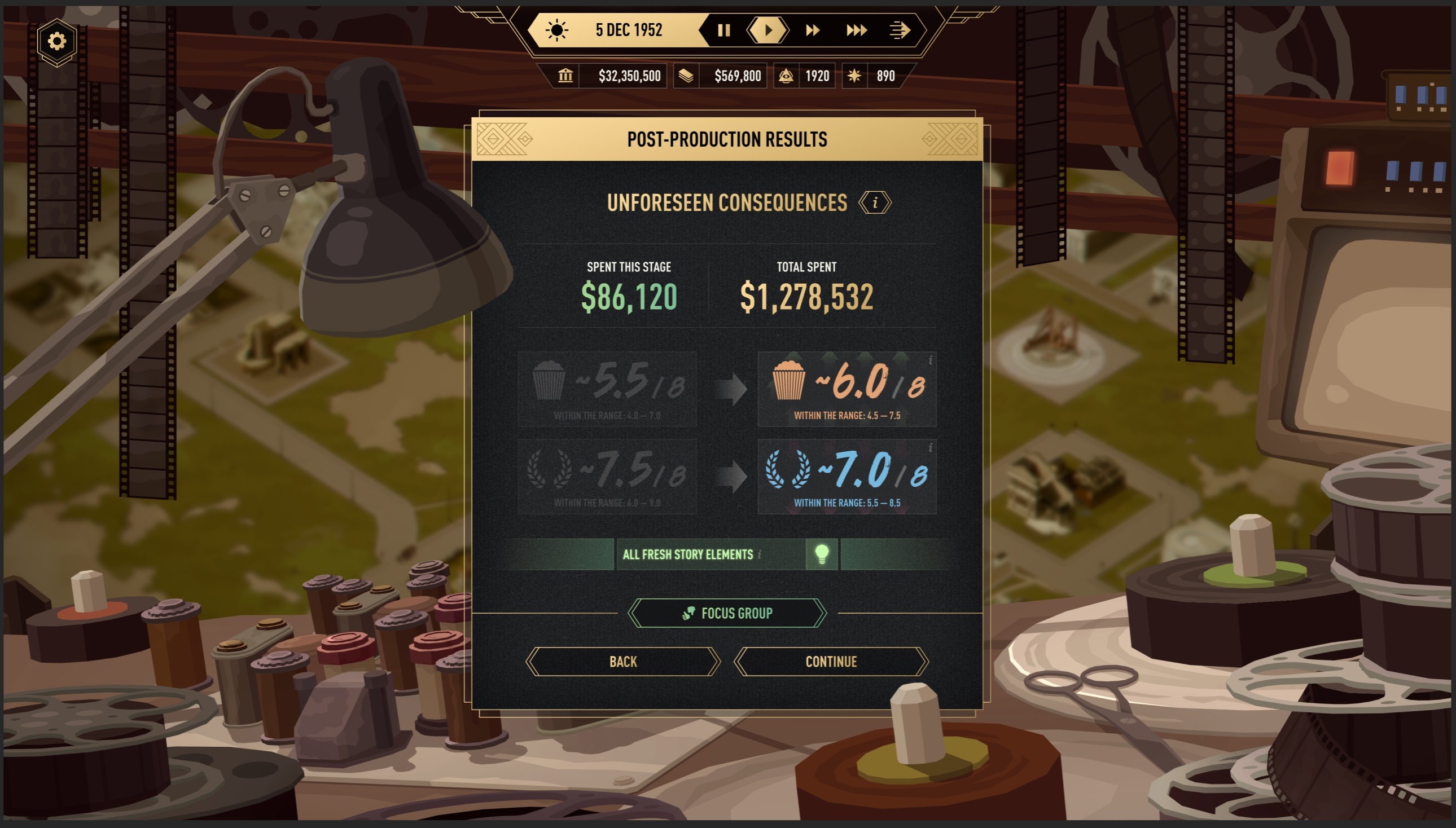
This range can be narrowed with upgrades, but to truly assess a film’s potential, you’ll need to screen it for a focus group. They’ll deliver a verdict, and also provide detailed feedback. Some of their concerns can be addressed (especially with a strong producer on the project), though that will cost time and money. Others you’ll simply have to keep in mind for the future.

But let’s stay optimistic: suppose the film is somehow completed and even receives warm feedback from test screenings. Now all that’s left is getting it to the audience. But there’s a catch: Act 1 ended with you and your competitors losing your theaters. That means a new force has entered the game: distributors. Each with their own interests, character, and weight in the industry.
Every release now involves tough negotiations. You’ll need to agree on a long list of factors — from the release date (which can now be set in advance, but missing it might lead to huge troubles) and the number of screens, to how revenue will be split. By default, the distributor holds the stronger position. To tilt things in your favor, you can leverage focus group results, star power, your reputation, prior partnerships, your marketing investment, and more. And if that still isn’t enough… well, a distributor’s representative is only human, with their own secrets and weaknesses.

Another potential advantage is a lavish premiere. If you own a suitable venue and are willing to invest in a high-profile event, it can generate additional attention for your film. And if you own several grand theaters, you can host multiple targeted premieres simultaneously: one for the film community, another for influential politicians and business figures, and a third for the press. And don’t forget to arrange interviews!

Given how much more complex and expensive film production becomes, relying on North American distribution alone may no longer be enough to generate decent profits. That’s why Act 2 introduces the ability to establish regional offices around the world. Opening and operating foreign branches will require significant investment, meeting specific conditions, hiring a manager (each with their own perks), and making a range of decisions, including how to localize your films through dubbing and subtitles. And of course, different regions have their own tastes and taboos — though you can always try and adjust your film accordingly.

International distribution isn’t your only path overseas. If fortune smiles on you, your film may be selected for premiere at the Monaco International Film Festival. And if you’re especially lucky, you might even take home a prestigious award, something that even audiences back in America will appreciate (presumably!).

But even after a successful global run, that’s not necessarily the end. Truly beloved pictures can live on television for decades. If you unlock enough upgrades, you’ll gain maximum flexibility: you can license your entire catalog to some TV network (each with its own specialization) for years ahead and keep things simple, or manage each deal individually to maximize returns.

Or you can take a principled stance and keep your films exclusively as a theatrical experience, proudly ignoring television altogether. After all, why feed the beast that might one day devour you?
_____________
While we’re not ready to announce an Act 2 release date just yet, we have decided how we want to approach its testing. The beta for our previous major update was a bit chaotic: it was difficult for us to keep track of all the feedback, follow up with players for additional details, and juggle multiple versions. This time, for the sake of efficiency, the beta will be closed, and we’d like to invite a small group (approximately 8–10 people) who will get access to Act 2 a few weeks early and help us balance and polish it.
Today’s update has added a new hidden achievement to the game. Anyone who unlocks it can apply to participate. To do so, please email us at [email protected] with the subject “Act 2 Beta”. Be sure to include a link to your Steam account (it must be public so we can verify the achievement) and your Discord account. If you’d like, feel free to tell us a bit about yourself, we’ll be happy to read it!
Beta participants will gain access to a private Discord channel where they can communicate with both us and each other. The language of communication will be English.
Thank you, and good luck!